De Quervain Thyroiditis: Mechanism and USMLE Clues
Distinguish De Quervain thyroiditis from Graves disease using thyroid pain, low iodine uptake, follicular destruction, and a worked USMLE vignette.
Subacute De Quervain thyroiditis causes thyrotoxicosis because inflamed thyroid follicles **release stored hormone**, not because the gland is making too much new hormone. The decisive combination is a painful, tender thyroid after a recent viral-type illness, elevated thyroid hormone with suppressed TSH, and low radioactive iodine uptake during the thyrotoxic phase.
That pattern contrasts with Graves disease, in which thyroid-stimulating antibodies drive hormone synthesis and iodine uptake is usually increased. The distinction explains both the laboratory findings and why antithyroid drugs are not useful for De Quervain thyroiditis. Endotext’s review of subacute thyroiditis describes these diagnostic differences. (ncbi.nlm.nih.gov)
Why a damaged thyroid releases hormone but takes up little iodine
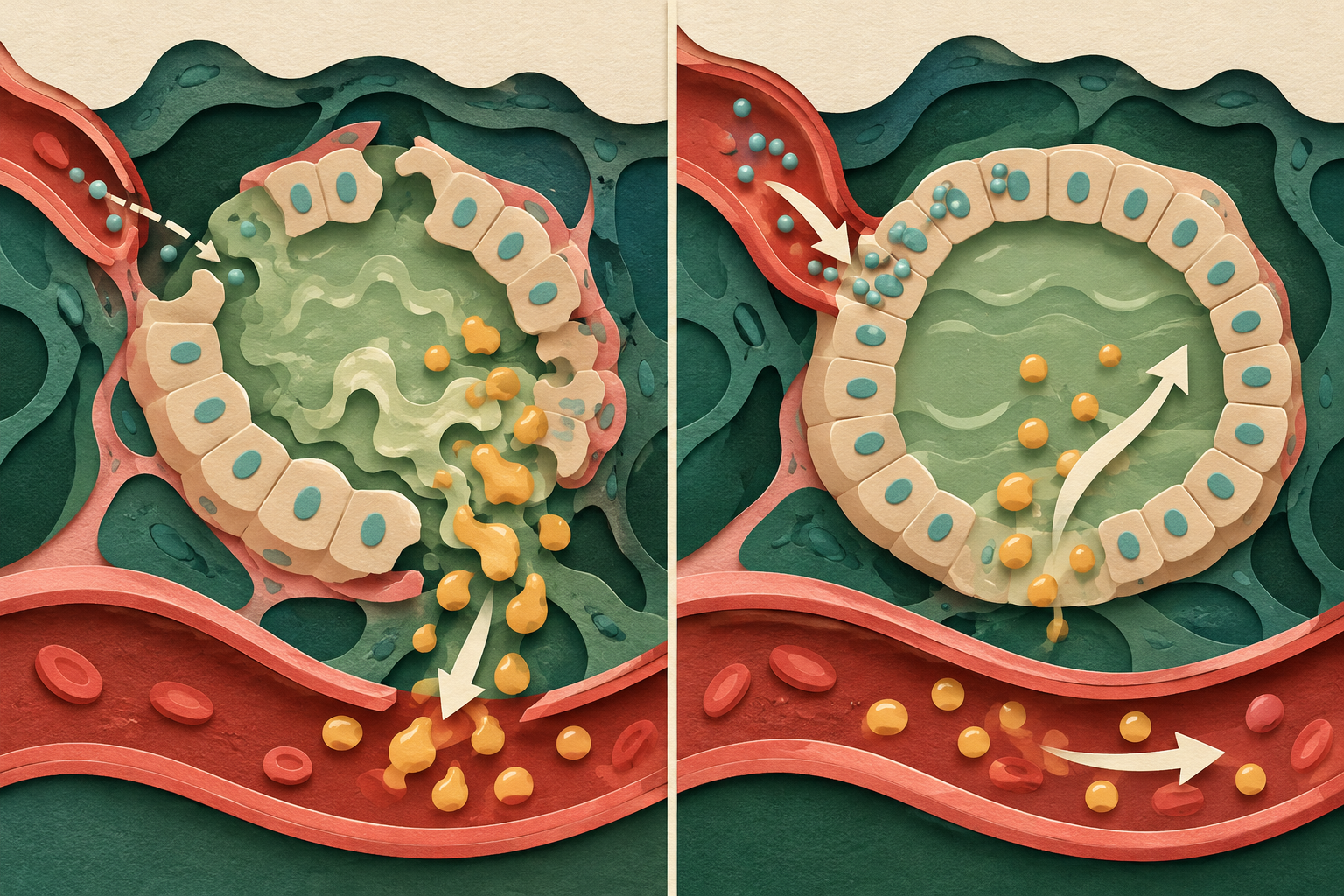
Thyroid follicles normally store thyroid hormone in colloid. In De Quervain thyroiditis, inflammation disrupts the follicles, allowing preformed T4 and T3 to enter the bloodstream. The resulting excess circulating hormone suppresses pituitary TSH through negative feedback.
The key distinction is between **hormone already in the blood** and **new hormone production by the gland**. During the early thyrotoxic phase, blood hormone concentrations can be high even though the inflamed gland is taking up little iodine and making relatively little new hormone. A low radioactive iodine uptake is therefore not contradictory; it is a clue that the excess hormone is coming from leakage. (ncbi.nlm.nih.gov)
Contrast this with the usual mechanism in Graves disease: TSH-receptor antibodies stimulate the gland, increasing hormone synthesis. The blood T4 may be high in either disorder, but the gland’s behavior differs. Graves typically produces increased, diffuse iodine uptake; destructive thyroiditis produces low uptake during the thyrotoxic phase. (ncbi.nlm.nih.gov)
This distinction also clarifies terminology. **Thyrotoxicosis** means excess thyroid hormone effect in the body. The term **hyperthyroidism** more specifically describes excess hormone synthesis by the thyroid, although it is sometimes used more broadly in clinical descriptions. De Quervain thyroiditis causes thyrotoxicosis without sustained increased synthesis.
Pain, inflammation, and giant cells: the clues that identify De Quervain
The classic presentation is anterior neck pain with a tender thyroid after a recent viral-type illness. Pain can radiate toward the jaw or ear, and patients may also report fatigue, fever, palpitations, or tremor. A preceding respiratory illness supports the diagnosis, but its absence does not exclude it. The association with viral illness does not establish a proven viral cause in every patient. MedlinePlus describes the characteristic presentation. (medlineplus.gov)
Inflammation provides another useful discriminator: ESR and C-reactive protein are commonly elevated. These markers are not specific to thyroiditis, but they reinforce the diagnosis when paired with a tender gland and the appropriate thyroid function tests. (ncbi.nlm.nih.gov)
On histology, the characteristic finding is **granulomatous inflammation with multinucleated giant cells** around disrupted follicles and colloid. This is a strong mechanistic clue in a pathology vignette: the follicular destruction explains hormone leakage. Biopsy is not routinely required when the clinical presentation is typical. (ncbi.nlm.nih.gov)
Pain is particularly valuable because low uptake alone is not unique to De Quervain thyroiditis. Painless thyroiditis can also cause destructive hormone release and low uptake. The tender gland and elevated inflammatory markers help distinguish the painful form. (ncbi.nlm.nih.gov)
Compare low-uptake thyroiditis with Graves and other distractors
The table compares typical findings during the **thyrotoxic phase**, when present. Individual patients can differ, and uptake results must be interpreted in clinical context. (ncbi.nlm.nih.gov)
| Diagnosis | Thyroid and clinical clues | Typical iodine uptake | Why it differs from De Quervain | |---|---|---|---| | **Subacute De Quervain thyroiditis** | Tender, painful gland; often follows a viral-type illness; ESR or CRP elevated | Low | Follicular injury releases stored hormone; granulomas with giant cells are characteristic | | **Graves disease** | Usually painless goiter; thyroid eye findings or positive TSH-receptor antibodies support the diagnosis | Usually increased and diffuse | Antibodies stimulate new hormone synthesis rather than primarily causing leakage | | **Painless or postpartum thyroiditis** | Painless gland; postpartum timing or autoimmune features may help | Low | Also destructive, so uptake alone does not distinguish it from De Quervain | | **Exogenous thyroid hormone use** | Medication history may reveal hormone ingestion; no inflammatory thyroid pain expected | Low | Hormone comes from outside the gland; thyroglobulin is typically suppressed | | **Acute suppurative thyroiditis** | Painful gland with infectious features; may have focal swelling or an abscess | Variable; low uptake can occur | A bacterial or other infectious process requires evaluation and treatment for infection |
A patient who looks acutely ill with focal neck swelling should not be assumed to have uncomplicated De Quervain thyroiditis just because the thyroid is painful. Acute suppurative thyroiditis can also cause pain and elevated inflammatory markers. Suspected infection calls for an evaluation for an abscess and, when appropriate, aspiration and microbiologic testing; antibiotics and drainage may be needed. (ncbi.nlm.nih.gov)
How thyroid tests change as the inflammation resolves
Thyroid function is not static in De Quervain thyroiditis. Interpreting a TSH result requires knowing when it was measured relative to the inflammatory episode.
- **Thyrotoxic phase:** Damaged follicles release stored hormone. Free T4 is elevated and TSH is suppressed; T3 can also be elevated. Pain and inflammatory markers are useful clues at this stage.
- **Transition toward euthyroidism:** As the excess circulating hormone clears, thyroid hormone levels may return to the reference range.
- **Possible hypothyroid phase:** Stored hormone has been depleted, and the recovering gland may temporarily be unable to meet the body’s needs. Free T4 can fall and TSH can rise.
- **Recovery:** Most patients regain normal thyroid function, although some develop lasting hypothyroidism.
Not every patient has a clearly recognizable version of every phase, and the timing varies. A normal TSH at one encounter does not erase an earlier destructive episode; likewise, hypothyroidism later in the course does not mean the original thyrotoxicosis was caused by Graves disease. Follow-up thyroid function testing helps establish the trajectory. (ncbi.nlm.nih.gov)
An original vignette: identify the source of excess hormone
A 38-year-old patient develops anterior neck pain that radiates toward the jaw two weeks after a respiratory illness. Examination shows a diffusely tender thyroid. The patient also has a tremor and a pulse of 108/min. TSH is suppressed, free T4 is elevated, and ESR is markedly elevated. Radioactive iodine uptake is low.
**Question:** Which process best explains the elevated free T4?
**Answer:** Release of preformed thyroid hormone from inflamed, disrupted follicles.
**Reasoning:** The patient has thyrotoxicosis, but low uptake argues against an actively synthesizing gland as the source. The tender thyroid, recent viral-type illness, and elevated ESR point to painful subacute thyroiditis. The lab pattern and physical findings fit one mechanism: inflammatory injury releases stored hormone while thyroid iodine uptake is suppressed.
**Why the nearest distractor loses:** Graves disease can also cause tremor, tachycardia, elevated free T4, and suppressed TSH. Those findings establish thyrotoxicosis but do not identify its cause. Graves is less consistent here because its stimulated gland usually has increased uptake, and the marked thyroid tenderness and inflammatory response favor De Quervain thyroiditis. Painless thyroiditis also explains low uptake, but not the vignette’s prominent thyroid pain. (ncbi.nlm.nih.gov)
If this vignette instead presented several weeks later with fatigue, elevated TSH, and low free T4, the earlier painful thyrotoxic episode would still be important. It would suggest the hypothyroid phase of the same destructive process rather than a second, unrelated diagnosis.
Treatment follows the mechanism: relieve inflammation, not synthesis
Management is generally supportive. Nonsteroidal anti-inflammatory drugs can relieve mild thyroid pain; glucocorticoids may be used for more severe pain or cases that do not respond adequately. A beta-blocker can reduce adrenergic symptoms such as tremor and tachycardia during the thyrotoxic phase. (medlineplus.gov)
**Methimazole and other thionamides are not indicated for the destructive thyrotoxic phase.** They inhibit new thyroid hormone synthesis, but the excess hormone in De Quervain thyroiditis is primarily leaking from damaged follicles. The same mechanistic reasoning distinguishes it from Graves disease, where suppressing synthesis can be useful. (ncbi.nlm.nih.gov)
If a symptomatic or significant hypothyroid phase develops, temporary thyroid hormone replacement may be needed. Continued thyroid function follow-up matters because most patients recover, while a minority have persistent hypothyroidism. Management should also be reconsidered if the presentation suggests an alternative cause, particularly acute infection. (medlineplus.gov)
Key takeaways
- **Painful thyroid plus thyrotoxicosis** after a viral-type illness suggests De Quervain thyroiditis, especially with elevated ESR or CRP.
- **Low iodine uptake during thyrotoxicosis** reflects destructive release of stored hormone, not increased synthesis.
- **Graves usually has increased diffuse uptake; painless thyroiditis has low uptake without the characteristic pain.**
- **Granulomas and multinucleated giant cells** link the pathology to follicular destruction.
- **Treat inflammation and symptoms**, and follow thyroid function through possible hypothyroidism and recovery.
For related endocrine concepts, explore the CoreStepPrep Core Concepts library. To apply the distinction in a question, Try a free USMLE question at CoreStepPrep.