Build a USMLE Error Log That Improves Each Block
Build a compact USMLE error log that reveals reasoning patterns, guides targeted question blocks, and turns weekly review into measurable progress.
A USMLE error log should do more than preserve a list of missed facts. Its real job is to change what you do next.
If reviewing a question produces a paragraph of copied explanation but no decision about your next block, the log is functioning as an archive—not a study tool. A useful error log compresses each important miss into a reasoning diagnosis, a corrected decision rule, and a targeted follow-up action.
That distinction matters for both Step 1 and Step 2 CK. Step 1 errors often expose gaps in mechanisms, causal chains, or interpretation of experimental findings. Step 2 CK errors more often require you to separate plausible diagnoses, recognize the patient’s current stage of care, or choose the next best action. In either case, the goal is not to memorize the original question. It is to become more likely to answer a different question testing the same decision correctly.
Why a decision-focused USMLE error log works
Practice questions combine retrieval, application, and feedback. A review of test-enhanced learning found that active retrieval—especially when repeated and paired with feedback—supports learning more effectively than study alone. That is the evidence-backed reason to return to corrected concepts through new questions rather than simply rereading explanations (PubMed review of test-enhanced learning).
The quality of feedback also matters. In a study involving medical students, response-oriented and conceptually focused feedback produced better retention and transfer than feedback that only reported whether an answer was right or wrong (study of feedback after formative multiple-choice tests).
An error log applies these principles when it makes you explain three things:
- **What decision did the question require?**
- **Why did your reasoning produce the wrong decision?**
- **What rule will you test on a new question?**
This is more useful than labeling every miss a “content gap.” Clinical reasoning research has separated errors involving identification of relevant information, interpretation, and hypothesis generation, supporting the value of examining where reasoning broke down rather than treating all wrong answers alike (clinical reasoning error analysis).
The practical recommendation that follows is simple: **log the failed decision process, not the entire question explanation.**
Use six fields that force a useful decision
A compact log entry should take roughly two to four minutes once you know the system. Use these six fields:
| Field | What to record | Example | |---|---|---| | Topic | A searchable concept, not a broad organ system | Nephrotic syndrome complications | | Tested decision | The exact task the item required | Identify the cause of sudden flank pain | | Failure type | Where your reasoning broke | Failed to connect hypercoagulability with renal vein thrombosis | | Misleading thought | The rule, assumption, or cue that pulled you away | “Flank pain plus hematuria means a stone” | | Corrected rule | A short rule that can transfer to another case | Nephrotic syndrome plus acute flank pain should raise renal vein thrombosis before nephrolithiasis | | Next action | The question block that will retest the weakness | 10–15 renal questions emphasizing nephrotic complications and vascular events |
The **misleading thought** is the most frequently omitted field and often the most valuable. “I did not know renal vein thrombosis” may be inaccurate if you recognized it immediately after reading the explanation. The actual problem may have been that you anchored on a familiar symptom pattern and failed to integrate the patient’s risk state.
Keep the corrected rule short enough to retrieve without reopening the source. If you need a full paragraph, you probably have not yet isolated the decision.
Log confident errors and unstable correct answers
Do not limit the log to incorrect questions. Include a correct answer when:
- You guessed between two options.
- Your reasoning contradicted the explanation.
- You selected the right option for the wrong reason.
- You could not explain why the strongest distractor was wrong.
- The same concept has appeared unstable in previous blocks.
Conversely, not every miss deserves an entry. A one-off arithmetic slip, an obscure detail, or a question you now understand completely may only need a quick note. Prioritize errors that are recurrent, transferable, or likely to affect multiple topics.
Diagnose the reasoning failure before reviewing more content
Use one primary label for each entry. Too many labels make weekly patterns difficult to see.
Knowledge failure
You lacked a fact, mechanism, criterion, adverse effect, or management principle required to answer.
**Corrective action:** Brief content repair followed by questions that require retrieval and application of that knowledge.
Cue-identification failure
You overlooked or underweighted a key clue such as timing, age, exposure, hemodynamic status, medication use, or a negative finding.
**Corrective action:** Practice extracting two or three decisive clues before looking at the options.
Interpretation failure
You noticed the relevant information but assigned it the wrong meaning. Examples include misreading an acid–base pattern, confusing central with peripheral endocrine findings, or misunderstanding what a test result does to a differential.
**Corrective action:** Rebuild the mechanism or interpretation sequence, then test it with varied presentations.
Discrimination failure
You generated the correct diagnosis or action but could not distinguish it from a close competitor.
**Corrective action:** Build a two-column contrast based on the smallest number of decisive differences, then complete a narrow block containing both alternatives.
Task failure
You answered a different question from the one asked. On Step 2 CK, this commonly means choosing the diagnosis when the prompt asks for confirmation, treatment, prevention, or the next step.
**Corrective action:** State the requested task in a few words before evaluating options: “diagnosis,” “best initial test,” “definitive treatment,” or “next step now.”
Execution failure
Your underlying knowledge was sufficient, but timing, answer changing, stem navigation, calculation, or fatigue disrupted performance.
**Corrective action:** Modify block conditions rather than assigning more content review.
Turn one missed question into one transferable rule
Review each selected question with a short reconstruction process:
- **Hide the explanation initially.** State what the question was testing and why you chose your answer.
- **Find the first faulty step.** Did you miss a clue, misinterpret it, generate the wrong possibilities, or answer the wrong task?
- **Read the explanation selectively.** Confirm the corrected reasoning and why the strongest competing option does not fit.
- **Write one decision rule.** Phrase it so that it could help on a new vignette.
- **Assign a next action.** Choose the smallest question set capable of testing the suspected weakness.
For example, imagine a Step 2 CK question about a postoperative patient with tachycardia, hypotension, elevated neck veins, and clear lungs. You chose IV fluids without recognizing obstructive shock.
A weak entry says:
Review obstructive shock and pulmonary embolism.
A decision-focused entry says:
**Failure:** I treated hypotension generically and ignored the combination of elevated jugular venous pressure and clear lungs. **Rule:** Postoperative instability with obstructive physiology requires immediate evaluation and management of a high-risk pulmonary embolism rather than routine volume replacement alone. **Next action:** Complete 10 mixed shock questions and classify each by hemodynamic pattern before selecting management.
The second version gives you a behavior to repeat and a block that can reveal whether the correction transfers.
Choose the next question block from the pattern, not your mood
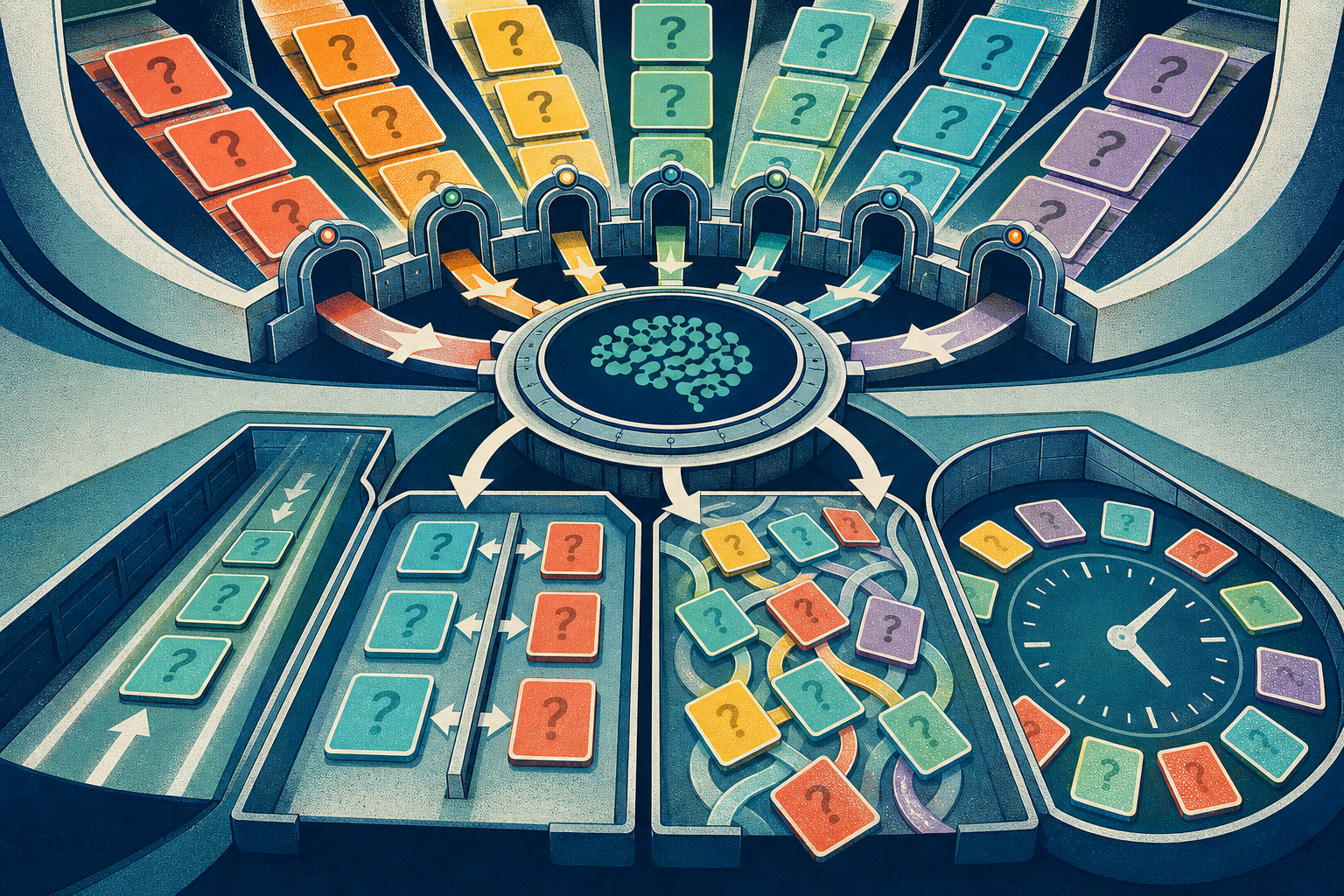
A single miss rarely justifies rebuilding your schedule. Look for clusters across several questions, then match the block design to the failure.
The following thresholds are **practical CoreStepPrep recommendations**, not official USMLE rules or validated score predictors:
| Pattern in your log | Next block | What success looks like | |---|---|---| | Three or more knowledge failures in one narrow topic | 10–20 focused questions after brief content repair | You can explain the mechanism before reading the options | | Repeated confusion between two diagnoses or treatments | Narrow comparison block containing both | You identify the discriminating clue consistently | | Cue-identification failures across several systems | Mixed block with a mandatory clue summary for each stem | You name the decisive findings before answering | | Task failures involving “next best step” | Management-heavy Step 2 CK block | You state the clinical task and patient stability first | | Errors appear mainly late in timed blocks | Timed mixed block under realistic break conditions | Accuracy and reasoning remain stable in the final portion | | One isolated content miss with no recurrence | Keep the next block mixed | No immediate schedule change is necessary |
Use official exam materials periodically to confirm that your practice remains aligned with the tested format and content framework. The USMLE Step 1 preparation materials include the content outline, sample questions, question-format guidance, and interactive testing resources.
For Step 1, targeted blocks may center on a mechanism, pathway, drug class, or data-interpretation skill. For Step 2 CK, they may center on a presentation, management stage, or distinction such as unstable versus stable care.
Do not stay in narrow blocks indefinitely. A focused block repairs the pattern; a later mixed block tests whether you can recognize the same decision without being told the topic.
Run a realistic weekly error-log review loop

The log becomes useful when it directs a recurring cycle of mixed practice, targeted repair, and transfer testing. Here is a sample week for a learner completing one main question block most days. Adjust the question count to your available time and study phase.
| Day | Main work | Error-log action | |---|---|---| | Monday | Mixed block | Log high-value misses and unstable correct answers | | Tuesday | Targeted block based on Monday’s strongest pattern | Check whether the same failure recurs | | Wednesday | Mixed block | Tag any recurrence; do not add duplicate explanations | | Thursday | Second targeted block or comparison set | Test a revised decision rule | | Friday | Timed mixed block | Evaluate transfer under less predictable conditions | | Saturday | Weekly review and short retest set | Count patterns, retire stable entries, select next week’s priority | | Sunday | Rest, light recall, or schedule reset | Carry forward no more than two active priorities |
During the Saturday review, sort the week’s entries by failure type and topic. Ask:
- Which error appeared at least twice?
- Which error could affect the widest range of questions?
- Did a targeted block reduce the failure, or merely make the topic feel familiar?
- Did the correction survive a mixed, timed setting?
- What single block would provide the clearest next test?
End the review with one or two active priorities. A long list creates diffuse studying; a short list creates a testable plan.
Define checkpoints that show whether the log is working
An error log should produce observable changes. Use three checkpoints.
The next-day checkpoint
Without reopening the explanation, retrieve the corrected rule and explain the strongest distractor. If you cannot, the entry may be too vague or the content repair incomplete.
The next-block checkpoint
Track whether the same failure occurs in a targeted set. Do not ask only, “Was my percentage higher?” Ask whether you executed the corrected behavior: identified the clue, interpreted the mechanism, stated the task, or separated the competing options.
The weekly transfer checkpoint
Test the repaired concept in a mixed block. An entry is ready to retire when you can apply the rule to a new presentation without advance warning and the same error is no longer recurring.
Consider tracking three simple weekly numbers:
- Total high-value entries
- Number belonging to the most common failure type
- Number of previously logged patterns that recurred
These are study-process indicators, not score predictions. Their purpose is to show whether your review is becoming more selective and whether repeated errors are actually decreasing.
Fix the failure modes that make error logs collapse
**The log takes longer than the question block.** You are copying too much. Limit entries to transferable misses and write rules in your own words.
**Every entry is labeled “content gap.”** Reconstruct your original reasoning before reading the explanation. If you knew the fact but failed to use it, classify the reasoning failure instead.
**You keep recording duplicates.** Add a tally or date to the original entry. Repetition is a signal to change the next block, not create another page of notes.
**Targeted blocks feel easy, but mixed blocks do not improve.** You may be recognizing the topic from the block label. Return to mixed questions and test whether you can identify the relevant framework independently.
**You review the log but never retest it.** Convert the two most important weekly patterns into question blocks. Rereading the log is not the endpoint.
**The log becomes emotionally punitive.** Describe the failed process neutrally. “I ignored the time course” produces a correction; “I always make careless mistakes” does not.
Final takeaways
- Record the failed decision, misleading thought, corrected rule, and next practice action—not a copied explanation.
- Separate knowledge failures from cue, interpretation, discrimination, task, and execution failures.
- Let recurring patterns determine the format and content of your next question block.
- Repair weaknesses with focused practice, then verify transfer in mixed and timed conditions.
- Review the log weekly, carry forward only one or two priorities, and retire entries that remain stable.
When your error log identifies the next decision you need to practice, it stops being a record of the past and becomes a plan for improvement. Build your next study block with CoreStepPrep.