Bacterial Genetics: Gene Transfer Mechanisms
Distinguish bacterial transformation, conjugation, and transduction using DNase, cell-contact, and phage clues, with a Step 1 vignette and comparison table.
Bacterial genetics questions often ask how a resistance or virulence trait moved from one bacterium to another. The decisive distinction is the delivery route: **transformation** takes up free DNA, **conjugation** requires cell-to-cell contact, and **transduction** uses a bacteriophage.
The same resistance phenotype can result from different genetic events, so the drug or organism alone may not identify the mechanism. Instead, look for what the experiment removes: extracellular DNA, contact between cells, or infectious phage particles.
Compare the routes of bacterial gene transfer
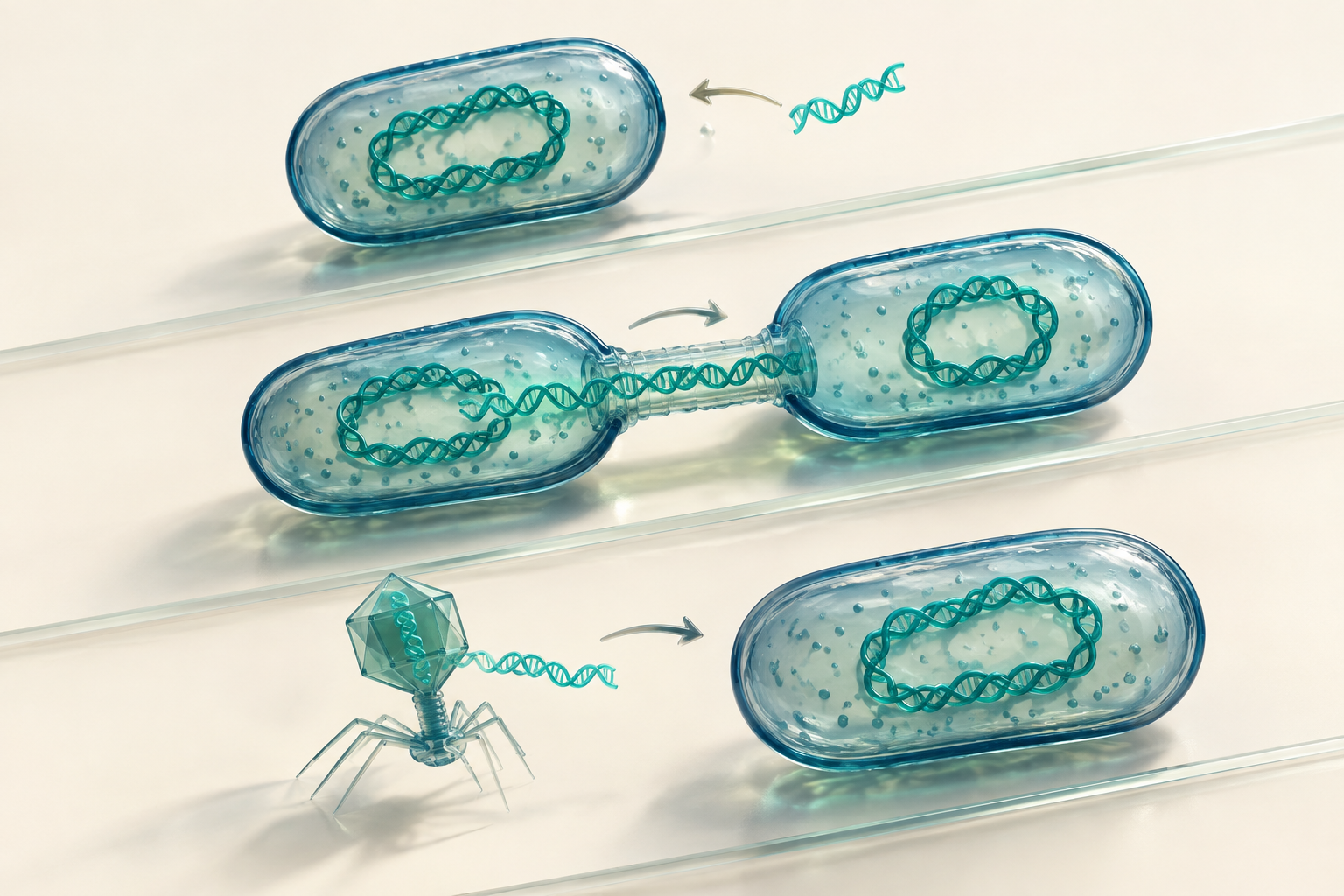
| Mechanism | What moves the genetic material? | Decisive clue | Important limitation | |---|---|---|---| | **Transformation** | A competent recipient takes up free extracellular DNA | Transfer is lost when exposed DNA is destroyed by DNase | The recipient must be able to take up DNA, and the DNA must be maintained or incorporated to persist | | **Conjugation** | A donor transfers DNA through a contact-dependent transfer apparatus | Transfer requires living donor and recipient cells to make contact | A plasmid is not necessarily conjugative just because it carries resistance genes | | **Transduction** | A bacteriophage particle delivers DNA to a recipient | Transfer follows exposure to an infectious, cell-free phage preparation | DNase may not destroy DNA protected inside the phage particle | | **Transposition** | A mobile DNA sequence changes position within or between DNA molecules | A resistance element moves from a chromosome to a plasmid, for example | Transposition alone does not describe passage between bacterial cells | | **Mutation** | A DNA sequence changes within a bacterial lineage | A new resistance-associated sequence variant appears without demonstrated DNA transfer | Selection can increase the mutant population; it does not prove horizontal transfer |
The table describes idealized experimental clues, not absolute rules for every laboratory. For example, a membrane must block bacterial contact while allowing the relevant material to pass before a separation experiment can distinguish mechanisms. Studies of contact-dependent transfer and the DNase sensitivity of pneumococcal transforming material illustrate why the experimental setup matters. (pmc.ncbi.nlm.nih.gov)
Transformation: free DNA enters a competent bacterium
In transformation, the recipient takes up DNA from its environment. The donor does not need to be alive or in contact with the recipient at the time of uptake: DNA released from bacteria can serve as the source.
A classic example is a nonencapsulated *Streptococcus pneumoniae* acquiring DNA associated with capsule production. The result is a heritable change in the recipient, not simply a capsule coating left behind by the donor. Pneumococcal experiments established that DNA preparations could induce this change and that DNase could destroy transforming activity. (pmc.ncbi.nlm.nih.gov)
Two steps matter. First, the recipient must be **competent** to take up the DNA. Second, the acquired material must be maintained: chromosomal fragments commonly persist by recombination with the recipient chromosome, whereas an appropriate plasmid may persist by replication. Merely encountering DNA is not enough to guarantee a heritable phenotype.
**Decisive experimental clue:** If a cell-free preparation transfers a trait, but pretreating the preparation with active DNase eliminates transfer, uptake of exposed DNA is a strong explanation. A membrane that keeps intact cells apart does not by itself rule out transformation, because free DNA can pass through a suitably designed barrier.
Conjugation: contact transfers DNA between cells
Conjugation is the contact-dependent movement of DNA from a donor to a recipient through a specialized transfer apparatus. In the classic F-plasmid model in gram-negative bacteria, a pilus helps establish contact, and plasmid DNA is transferred into the recipient. Conjugative plasmids can also carry antibiotic-resistance genes.
The key observation is **dependence on contact**, not simply the presence of a plasmid. A plasmid may be nonconjugative, or it may require transfer machinery supplied by another element. Conversely, conjugative systems can transfer genetic material other than a simple resistance plasmid.
In a classic F⁺ × F⁻ pairing, the donor carries the F plasmid and the recipient does not. Transfer of the F plasmid can give the recipient the ability to act as a donor. If the F factor is integrated into the bacterial chromosome, an **Hfr** donor can initiate transfer of adjacent chromosomal genes; the entire integrated F factor is often not transferred, so the recipient commonly remains F⁻.
An experimental barrier that prevents donor–recipient contact can therefore interrupt conjugation even if it allows small molecules and free DNA through. In an experimental study of a staphylococcal plasmid, investigators tested contact dependence alongside controls for phage-mediated transfer. (pmc.ncbi.nlm.nih.gov)
**DNase interpretation:** Conjugative transfer is generally resistant to extracellular DNase because the DNA is protected during cell-to-cell passage. DNase resistance alone is not enough to diagnose conjugation, however: phage-protected DNA can also escape extracellular DNase.
Transduction: a bacteriophage delivers DNA
In transduction, a bacteriophage carries bacterial DNA from a donor to a recipient. The question is not whether a virus is mentioned somewhere in the stem, but whether a phage particle is the **delivery vehicle** for the genetic material.
A cell-free filtrate can therefore transmit a trait if infectious phage particles pass through the filter. Extracellular DNase may leave this activity intact because the DNA is protected by the phage particle. Evidence that the activity depends on infectious phage helps distinguish transduction from transformation.
Generalized versus specialized transduction
**Generalized transduction** occurs when a phage particle packages bacterial DNA. Different particles can carry different bacterial chromosomal fragments, so the transferable DNA is not restricted to genes next to one prophage insertion site.
**Specialized transduction**, in the classic model, follows abnormal excision of an integrated prophage. The resulting phage DNA includes nearby bacterial chromosomal DNA, so the transferred bacterial genes are limited by their location near the prophage insertion site. A primary study of specialized transducing phages demonstrated transfer associated with improper prophage excision. (pmc.ncbi.nlm.nih.gov)
The useful distinction is **which DNA is packaged**:
- A variety of donor bacterial genes can be transferred → generalized transduction.
- Only bacterial genes adjacent to an integrated prophage are carried after abnormal excision → specialized transduction.
Lysogenic conversion is a related but different idea
Lysogenic conversion describes a change in bacterial phenotype caused by expression of **phage-encoded genes** in a lysogen. For example, acquisition of a phage carrying the diphtheria toxin gene can give *Corynebacterium diphtheriae* the capacity to produce toxin. Experimental work has demonstrated expression of the phage-associated toxin gene. (pmc.ncbi.nlm.nih.gov)
Do not equate that example with specialized transduction. In specialized transduction, the defining cargo is **adjacent bacterial DNA** accidentally carried after abnormal prophage excision. In lysogenic conversion, the defining new trait comes from a **phage gene** expressed in the bacterium. Both involve temperate phages, but the question is asking about different genetic cargo.
Transposons and mutations: close distractors, different events
A transposon is a mobile DNA segment that can move to a new site in DNA. Some transposons carry resistance genes and can move between a chromosome and a plasmid. If that plasmid then transfers by conjugation, two mechanisms have occurred: **transposition** placed the element on the plasmid, and **conjugation** moved the plasmid between cells. A study of mobile elements in clinical isolates demonstrates how transposition can reshape plasmids that participate in resistance transfer. (pmc.ncbi.nlm.nih.gov)
Mutation is different again: it changes a DNA sequence and does not require acquisition of DNA from another organism. For example, certain mutations in *rpoB*, which encodes a subunit of bacterial RNA polymerase, can confer rifampin resistance. Resistant variants may then be selected when susceptible bacteria are inhibited. Laboratory work has characterized rifampin-resistant mutants with rpoB changes. (pmc.ncbi.nlm.nih.gov)
A mutation can also be transmitted to descendants, and a resistance gene can be exchanged horizontally. The presence of resistance after antibiotic exposure does not, by itself, tell you which event produced it.
Worked vignette: identify the route from the experiment
An investigator mixes a drug-resistant bacterial donor with a susceptible recipient. After incubation, some recipients grow on medium containing the drug. Transfer still occurs when extracellular DNase is added. However, no resistant recipients are recovered when the two strains are placed on opposite sides of a membrane that prevents bacterial contact but permits free DNA and phage particles to cross. Control experiments confirm that both strains remain viable and that the DNase is active.
**Which mechanism best explains the transfer?**
**Answer: conjugation.** The decisive clue is loss of transfer when cell contact is prevented. Continued transfer in the presence of active extracellular DNase supports a protected transfer route rather than uptake of exposed DNA.
**Why the nearest distractor loses:** Transduction can also be DNase resistant, but in this experiment the membrane permits phage particles to cross while blocking contact. The loss of transfer across that barrier therefore favors a contact-dependent mechanism over phage delivery. Transformation is less likely because active DNase does not stop transfer. A transposon could be present on the transferred DNA, but the observations identify the **between-cell route**, not the movement of a DNA segment within or between replicons.
In an actual experiment, these conclusions depend on the controls: a membrane that also blocks the relevant phage particles would not provide the same discrimination.
Key takeaways
- **Free DNA plus DNase-sensitive transfer** points toward transformation.
- **Required cell-to-cell contact** points toward conjugation; a resistance plasmid alone is not proof of the route.
- **Phage-particle delivery** points toward transduction. Generalized transduction can move varied bacterial genes; specialized transduction is restricted to genes near the prophage insertion site.
- **Lysogenic conversion** is a phenotype caused by phage genes, whereas transposition moves a DNA element to a new location.
- **Resistance alone does not identify a mechanism:** use the experiment’s DNA, contact, and phage clues.
For related microbiology foundations, explore the CoreStepPrep core concepts. Then Try a free USMLE question at CoreStepPrep.