Antimicrobial Medications: β-Lactams vs Vancomycin
Compare β-lactams and vancomycin using MSSA and MRSA clues, resistance mechanisms, and a worked USMLE-style bacteremia vignette.
When a *Staphylococcus aureus* blood culture returns, the key antimicrobial distinction is whether the isolate is methicillin-susceptible or methicillin-resistant. For methicillin-susceptible *S. aureus* (MSSA) bacteremia, an appropriate β-lactam such as cefazolin is usually preferred; for methicillin-resistant *S. aureus* (MRSA) bacteremia, intravenous vancomycin is a common choice because it acts at a different cell-wall target.
The mechanism explains the choice: most β-lactams inhibit penicillin-binding proteins, whereas vancomycin binds the cell-wall precursor itself. MRSA commonly escapes the first mechanism through an altered penicillin-binding protein, not by destroying vancomycin. Susceptibility results, the infection site, allergies, and the patient's clinical condition still matter when selecting treatment. Evidence on definitive MSSA therapy; MRSA bacteremia trial.
β-Lactams and vancomycin interrupt cell-wall construction differently
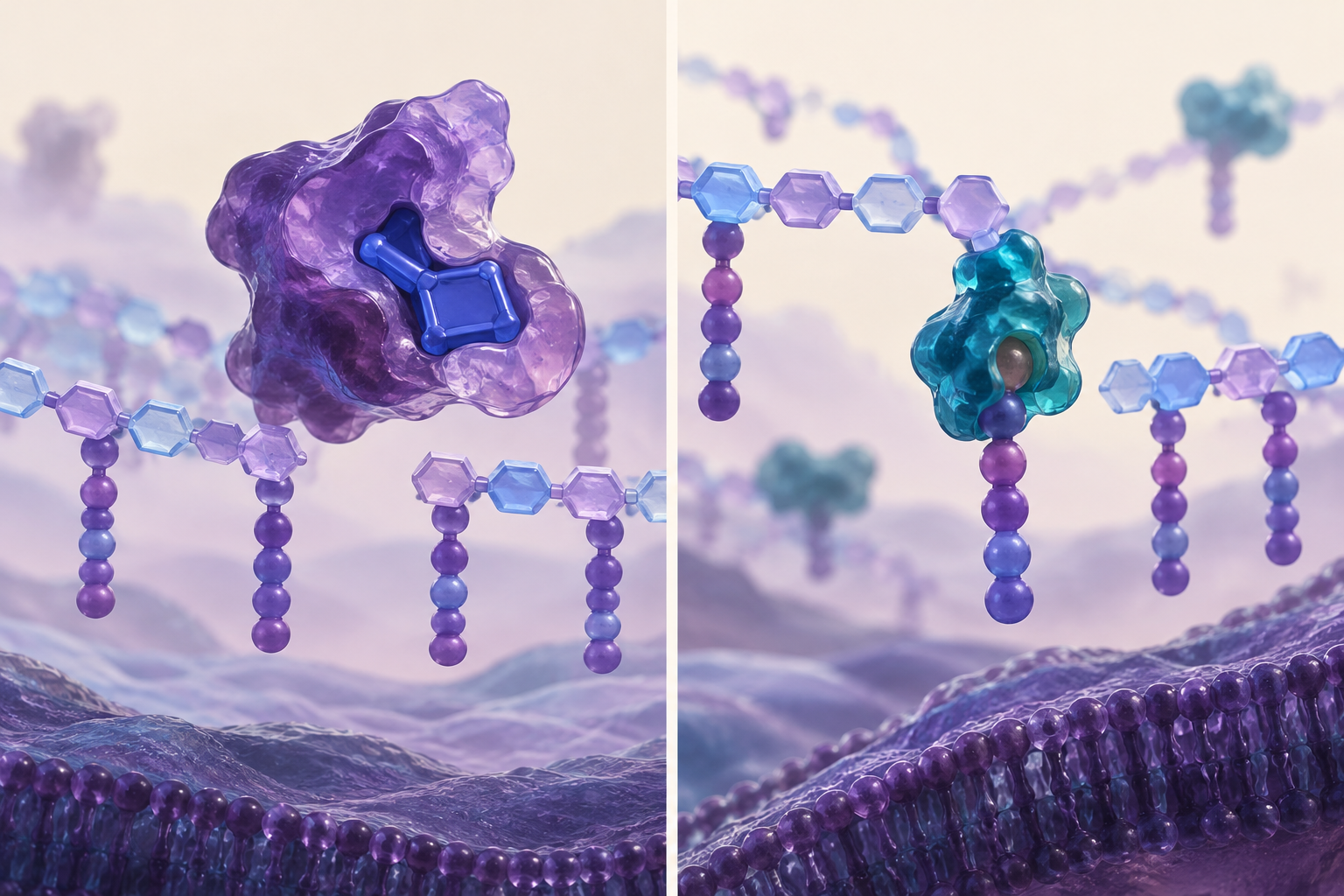
Bacteria build a protective peptidoglycan wall from repeating sugar chains with short peptide side chains. Penicillin-binding proteins (PBPs), including transpeptidases, help cross-link those peptide side chains. Cross-linking gives the wall strength against osmotic pressure.
**β-Lactams bind PBPs and inhibit cross-linking.** For a susceptible, actively growing bacterium, the weakened wall can lead to cell death. Penicillins and cephalosporins share this basic target, but their binding properties and spectra differ: the class name alone does not establish whether a particular drug covers MRSA.
**Vancomycin binds the D-Ala-D-Ala terminus of a peptidoglycan precursor.** By occupying the precursor, it interferes with cell-wall assembly, including cross-linking. Its target is therefore a peptide building block, not the PBP enzyme. That distinction explains why a change in a PBP can defeat many β-lactams without necessarily defeating vancomycin. The molecular study of vancomycin resistance illustrates how altering the precursor instead can reduce vancomycin binding.
Both drug groups are generally bactericidal against susceptible *S. aureus*. But **bactericidal is not a synonym for best drug**: activity against the isolate, the infection site, toxicity, and clinical evidence also determine the choice. Vancomycin's effect is not identical against every organism; it may be bacteriostatic against enterococci.
Compare resistance clues before choosing a drug
The table separates three mechanisms that can all appear in cell-wall pharmacology questions. The first two concern *S. aureus*; the third is an important mechanistic contrast involving enterococci.
| Finding | What changes? | Consequence | Treatment implication | |---|---|---|---| | Penicillinase-producing MSSA | A β-lactamase breaks the β-lactam ring of susceptible drugs | Penicillin G may fail, even though the isolate remains methicillin-susceptible | For susceptible MSSA bacteremia, cefazolin or an antistaphylococcal penicillin is generally appropriate | | MRSA with *mecA* | PBP2a has low affinity for most β-lactams | Drugs such as nafcillin and cefazolin do not reliably inhibit cell-wall cross-linking | IV vancomycin is a common option for serious susceptible MRSA infection; ceftaroline is an important β-lactam exception | | VanA-type vancomycin-resistant enterococcus | The precursor terminus changes from D-Ala-D-Ala to D-Ala-D-Lac | Vancomycin binds poorly to the altered precursor | Select another active agent based on the species, susceptibility, and infection site |
These are different problems: **enzyme-mediated drug destruction**, **an altered enzyme target**, and **an altered cell-wall precursor**. The presence of one does not prove the presence of another. Studies of staphylococcal β-lactamase, PBP2a and ceftaroline, and VanA-mediated precursor remodeling demonstrate the distinction.
Why a β-lactamase inhibitor does not automatically fix MRSA
A β-lactamase inhibitor can protect a partner drug against certain β-lactamases. It does not, however, convert PBP2a into a PBP that nafcillin binds effectively. In the classic *mecA*-mediated MRSA mechanism, the major obstacle is the altered target. Do not select a β-lactamase inhibitor merely because the stem says “resistant.”
Likewise, an isolate can resist penicillin G through β-lactamase production and still be MSSA. “Methicillin-susceptible” is not the same claim as “susceptible to every penicillin.” Read the specific susceptibility result rather than extrapolating from the organism's name.
The ceftaroline exception
Ceftaroline is a cephalosporin with affinity for PBP2a, so it can have activity against MRSA despite being a β-lactam. That makes it a useful exception to the shorthand that MRSA resists β-lactams. It does **not** mean every MRSA isolate is susceptible: clinical isolate research has documented reduced ceftaroline susceptibility associated with changes in PBP2a. The site of infection, clinical situation, and susceptibility testing remain relevant.
Use the culture result to distinguish empiric from definitive therapy
Before susceptibility results return, a seriously ill patient with suspected *S. aureus* bacteremia may need empiric treatment active against MRSA. IV vancomycin is a common choice while the team awaits identification and susceptibility data. Empiric treatment addresses uncertainty; it is not necessarily the drug to continue after that uncertainty resolves.
Once blood cultures identify **MSSA**, cefazolin or an antistaphylococcal penicillin such as nafcillin is generally preferred for definitive therapy when appropriate for the patient. In a multihospital retrospective cohort, definitive β-lactam treatment was associated with lower mortality than definitive vancomycin treatment. This was observational evidence, not proof that switching alone caused the difference, but it supports the distinction between empiric and definitive choices.
If cultures instead identify **MRSA susceptible to vancomycin**, IV vancomycin remains a common treatment for bacteremia. Daptomycin is another option for MRSA bacteremia in appropriate circumstances; the choice depends on factors including the infection site and patient-specific risks. A randomized trial in MRSA bacteremia used IV vancomycin or daptomycin as standard therapy.
Route matters. Oral vancomycin is used for selected intestinal infections; it should not be substituted for IV vancomycin to treat a bloodstream infection. Conversely, choosing the right IV drug does not complete the evaluation. For *S. aureus* bacteremia, follow-up blood cultures, evaluation for endocarditis and other infection sites, and source control are important parts of care. A multicenter bacteremia cohort examined these management measures.
Worked vignette: change therapy when MSSA is identified
A 58-year-old man is admitted with fever and hypotension. Blood cultures are obtained, and he is started on IV vancomycin while results are pending. The cultures grow *S. aureus*. The laboratory reports that the isolate is susceptible to oxacillin and cefazolin but resistant to penicillin G. He has no reported β-lactam allergy. Which antimicrobial change best targets the bloodstream isolate?
**Answer: switch to IV cefazolin.**
**Decisive clue:** Oxacillin susceptibility identifies the isolate as MSSA in this clinical comparison, and the laboratory also reports cefazolin susceptibility. For MSSA bacteremia, a targeted β-lactam is generally preferred over continuing vancomycin when the patient can receive it.
**Why the nearest distractor loses:** Continuing IV vancomycin is understandable before the susceptibility report because it covers MRSA. Once this isolate is identified as susceptible MSSA, however, the rationale for keeping vancomycin as the definitive drug is weaker than the rationale for using cefazolin. The penicillin G result does not overturn the cefazolin result: resistance to one β-lactam can reflect β-lactamase activity rather than the altered PBP associated with classic MRSA.
**Why penicillin G loses:** The laboratory directly reports resistance. A familiar narrow-spectrum drug is not an appropriate targeted choice when the organism is resistant to it.
The vignette asks for the antimicrobial decision, not the entire bacteremia plan. The team must also establish clearance of blood cultures, look for a source and complications, and determine treatment duration from the clinical findings. For more pharmacology background, explore the CoreStepPrep core concepts.
Common cell-wall antimicrobial pitfalls
**Mistaking MRSA for VRE.** MRSA is a classification of *S. aureus* based on methicillin resistance; VRE refers to vancomycin-resistant enterococci. Classic MRSA resistance involves PBP2a, whereas VanA-type resistance changes the precursor terminus. MRSA does not automatically mean vancomycin resistance, and VRE does not automatically mean PBP2a.
**Treating every β-lactam as interchangeable.** Nafcillin and cefazolin are useful for susceptible MSSA, but they do not reliably treat MRSA. Ceftaroline has different PBP2a binding properties. Even then, susceptibility and clinical context matter.
**Equating broad empiric coverage with the best definitive choice.** The best initial drug must cover plausible pathogens while information is incomplete. The best definitive drug responds to the organism and susceptibility report once available. In the vignette, changing from vancomycin to cefazolin is a response to new evidence, not a correction of necessarily inappropriate empiric care.
**Stopping at the drug name.** A correct antibiotic cannot replace assessment for a removable infected device, drainable focus, endocarditis, or persistent bacteremia. Those findings can change the intervention and duration needed.
Key takeaways
- β-Lactams inhibit PBPs; vancomycin binds the D-Ala-D-Ala cell-wall precursor.
- Classic *mecA*-mediated MRSA resistance involves PBP2a, which has low affinity for most β-lactams; ceftaroline is an important exception.
- Penicillinase production and PBP2a-mediated resistance are different mechanisms. Penicillin G resistance alone does not establish MRSA.
- For susceptible MSSA bacteremia, cefazolin or an antistaphylococcal penicillin is generally preferred for definitive treatment when appropriate; IV vancomycin is a common option for susceptible MRSA bacteremia.
- VanA-type enterococci replace D-Ala-D-Ala with D-Ala-D-Lac, reducing vancomycin binding.
Apply the distinction to another clinical scenario: Try a free USMLE question at CoreStepPrep.