System-Based vs Mixed USMLE Question Blocks
Learn when to use system-based or mixed USMLE blocks, how to switch by study phase, and which performance signals should drive the decision.
Most learners do not need to choose between system-based and mixed USMLE question blocks forever. They need to choose the right format for the learning problem in front of them.
Use **system-based blocks** when you are still building a framework, repairing a concentrated weakness, or learning how a group of related diseases differs. Use **mixed blocks** when you need to retrieve knowledge without topic cues, discriminate among competing diagnoses, and measure whether your knowledge transfers across the exam blueprint.
The key is to switch based on performance—not comfort. Staying system-based too long can create inflated confidence because the block itself tells you what kind of answer to expect. Switching to mixed blocks too early can produce scattered errors without giving you enough repetition to repair the underlying system.
What system-based and mixed blocks actually train
A system-based block limits questions to an area such as cardiology, renal medicine, or neurology. This reduces the number of plausible frameworks you must consider. If every question is renal, an acid-base vignette is already partially classified before you read it.
That cue is useful during learning. It allows you to:
- Repeatedly apply the same physiology or clinical framework.
- Compare closely related diagnoses.
- Identify recurring gaps within one system.
- Connect foundational science to pathology, pharmacology, diagnosis, or management.
A mixed block removes that advance cue. A patient with fatigue might have anemia, hypothyroidism, depression, heart failure, malignancy, or medication toxicity. You must first decide which framework applies and then retrieve the relevant details.
That format trains:
- Uncued retrieval across systems.
- Recognition of the vignette’s true task.
- Discrimination among plausible alternatives.
- Transitions between unrelated topics under time pressure.
Question-based study is a form of retrieval practice. In an observational study of medical students, greater use of board-style practice questions was associated with stronger licensing-exam performance, although an association does not prove that question volume alone caused the difference (research on retrieval practice and medical licensing performance). The practical implication is not simply to complete more questions. It is to make each block retrieve the kind of knowledge you currently need to strengthen.
Why mixed blocks feel harder even when they are more useful
System-based practice often produces faster score gains because related questions reactivate the same mental model. After reviewing nephrotic syndromes, you may answer several related questions correctly while the comparison table remains fresh.
Mixed practice creates more retrieval distance. The learner must recognize the domain, select an approach, and distinguish the correct answer from options drawn from other domains. Experimental work on category learning suggests that interleaving can improve discrimination by placing different categories in contrast, although that evidence should not be treated as a direct trial of USMLE question-bank scheduling (study of interleaving, retrieval, and category discrimination).
This explains a common experience: your percentage may fall when you first switch to mixed blocks even though the practice is becoming more exam-relevant. A short-lived decline is not automatically a reason to retreat. It may reveal that your system-based performance depended partly on contextual cues.
The correct response depends on the error pattern. If you recognize the tested condition but confuse it with a close alternative, continue mixed practice and improve discrimination. If you cannot explain the underlying mechanism or management pathway after reviewing the answer, return temporarily to targeted repair.
A phase-based decision framework for USMLE blocks
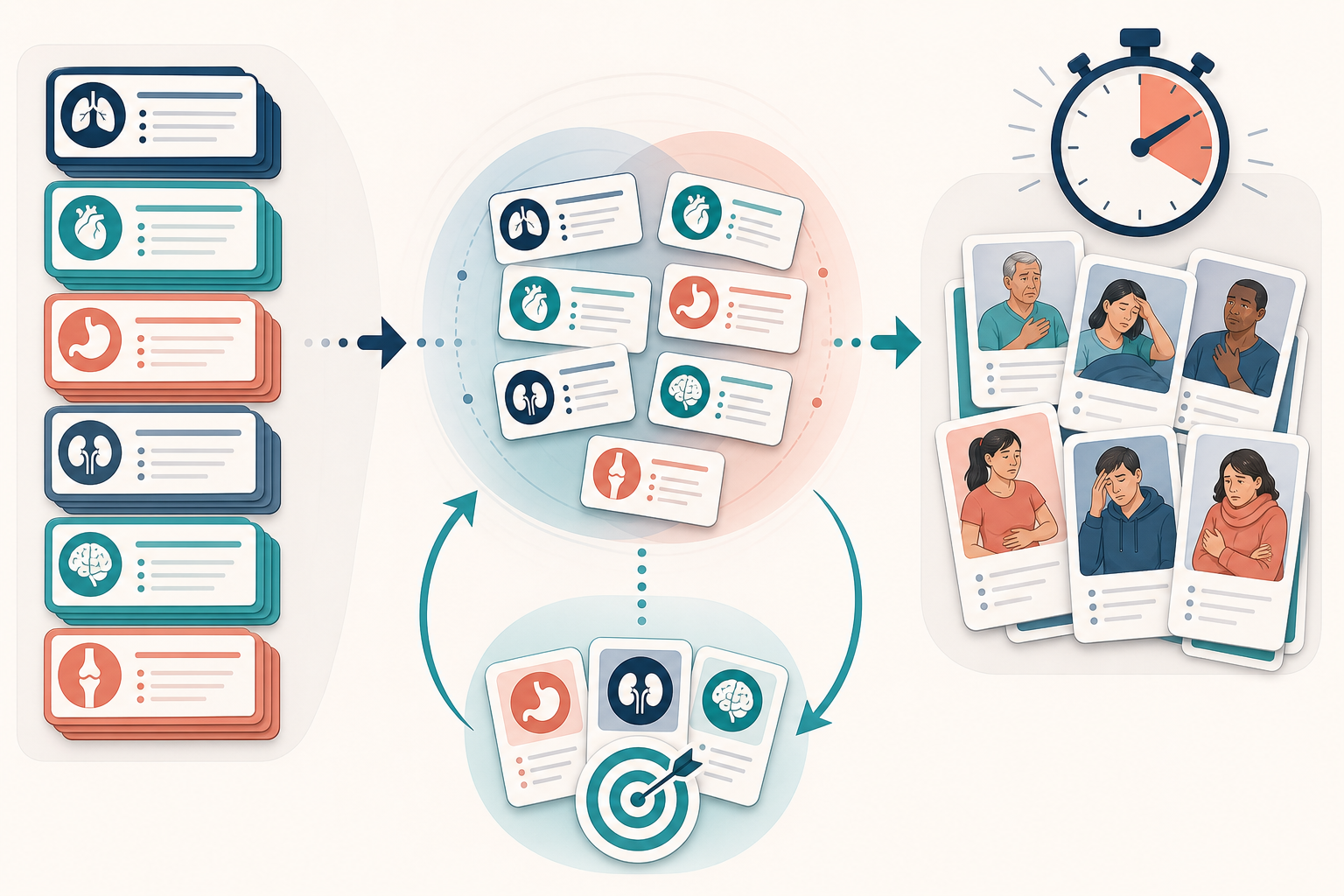
The following thresholds are practical recommendations, not official USMLE cutoffs or validated score predictions. Adjust them to your question bank, baseline, and school requirements. Use trends across several blocks rather than making a major change after one unusually easy or difficult set.
| Study phase | Default block format | What you are trying to learn | Signal to advance or adjust | |---|---|---|---| | Initial content acquisition | Mostly system-based | Build mechanisms, illness scripts, and management pathways | You can explain most reviewed questions without reopening a primary resource | | Weak-system repair | Short system-based sequence plus mixed exposure | Correct a concentrated deficit without losing broad retrieval | The system improves across two or three blocks and errors are no longer mostly knowledge gaps | | Integration | Approximately half system-based and half mixed | Test transfer while finishing targeted repair | Mixed performance becomes stable and you can identify the tested system without relying on block labels | | Dedicated exam preparation | Mostly mixed, timed blocks | Practice uncued retrieval, discrimination, pacing, and switching | Assessment trends and error patterns show readiness; remaining weaknesses are handled with brief targeted sets | | Final stretch | Mixed blocks with selective mini-sets | Preserve exam-like retrieval while closing narrow gaps | No single system repeatedly drives a disproportionate share of actionable errors |
Early learning: use system-based blocks to build usable frameworks
System-based blocks are most valuable when you cannot yet organize the material. For Step 1, this may mean integrating cardiac physiology, murmurs, antiarrhythmics, and congenital lesions. For Step 2 CK, it may mean building a consistent approach to chest pain, arrhythmias, heart failure, and valvular disease.
A realistic early workflow is:
- Review a focused resource for 30–60 minutes.
- Complete 10–20 questions from that system.
- Review every question, including correct answers reached through guessing.
- Record the governing rule and the feature that separates the correct answer from the closest distractor.
- Complete another targeted set one or two days later without rereading first.
Do not wait for mastery before answering questions. The block is part of learning, not merely a test after learning.
Integration: pair targeted repair with mixed retrieval
Once you possess a workable framework, begin alternating formats. A learner studying six days per week might use this schedule:
| Day | Primary block | Secondary task | |---|---|---| | Monday | Mixed, timed | Review and classify errors | | Tuesday | Weak-system targeted | Repair the top recurring mechanism or algorithm | | Wednesday | Mixed, timed | Reattempt selected concepts without notes | | Thursday | Weak-system targeted | Compare commonly confused diagnoses | | Friday | Mixed, timed | Track pacing and changes between first and final answers | | Saturday | Mixed or self-assessment-style session | Weekly trend review and next-week planning | | Sunday | Rest or light recall | No large new question set |
This hybrid phase prevents two mistakes: abandoning a weak system before it improves and hiding inside targeted blocks after the system cue has become a crutch.
Dedicated preparation: make mixed blocks the default
As the exam approaches, mixed blocks should usually dominate because the exam will not announce the system before each vignette. The official USMLE preparation hub provides separate Step 1 and Step 2 CK practice materials and testing resources; use those materials to calibrate your preparation to the examination you will actually take (official USMLE exam preparation resources).
Targeted questions still have a role, but they should become a repair tool rather than the main testing environment. For example, if a mixed block exposes repeated errors in obstructive versus restrictive lung disease, complete a short pulmonary set, rebuild the comparison, and then verify the repair in another mixed block.
Performance signals that should trigger the switch
Do not switch formats simply because you finished a chapter or reached a particular week. Use your review data.
Move from system-based toward mixed blocks when
- Your targeted percentage has stabilized across at least two or three blocks.
- Most misses are caused by subtle discrimination, interpretation, or execution rather than total unfamiliarity.
- You can state why the best answer is correct and why the closest alternative is wrong.
- You can solve questions from the system after a gap of several days.
- The topic label feels increasingly unnecessary.
A useful operational checkpoint is to ask: **If this exact vignette appeared in a mixed block, would I know which framework to retrieve?** If the answer is usually yes, start removing the cue.
Return briefly to system-based repair when
- One system creates a repeated cluster of errors across several mixed blocks.
- You cannot reconstruct the relevant mechanism, diagnostic sequence, or management pathway during review.
- Your errors within that system are broad rather than limited to one difficult subtopic.
- You repeatedly select answers from the wrong stage of care, such as definitive testing before stabilization.
- Mixed review produces a long list of isolated facts but no coherent framework.
The return should be limited and defined. For example: “I will complete two renal blocks, review acid-base reasoning, and then test the repair in the next two mixed blocks.” Avoid open-ended plans such as “I will stay in renal until I feel confident.”
Turn block data into a decision dashboard
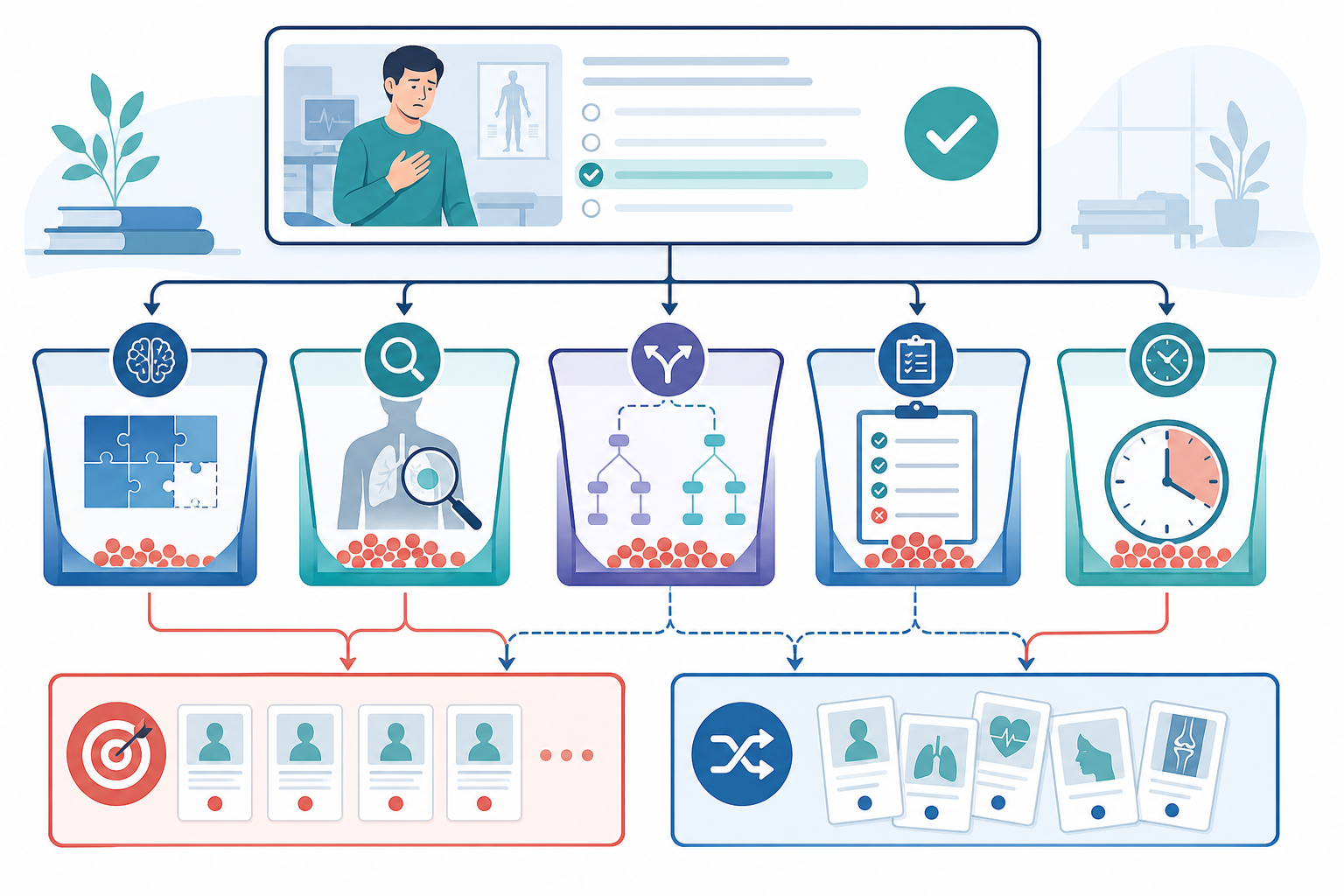
Raw percentage alone is a weak guide because it does not explain why performance changed. After each block, classify every incorrect answer and every correct answer reached through low-confidence guessing.
Use five categories:
- **Knowledge:** You did not know the tested fact, mechanism, or guideline.
- **Recognition:** You knew the content but failed to identify the disease or task.
- **Discrimination:** You narrowed the options but confused two plausible answers.
- **Execution:** You misread, changed a correct answer without justification, or made a calculation error.
- **Timing:** You rushed, left items incomplete, or spent too long on earlier questions.
Then use the distribution to select the next block:
| Dominant error pattern | Best next move | |---|---| | Knowledge errors concentrated in one system | Short system-based repair sequence | | Recognition errors across many systems | Continue mixed blocks and practice identifying the vignette’s task | | Discrimination errors between similar diagnoses | Mixed blocks plus focused comparison notes | | Execution errors despite adequate knowledge | Timed mixed blocks with a deliberate answering routine | | Timing errors late in blocks | Timed mixed practice and pacing checkpoints | | No dominant pattern after one block | Collect more data before changing the plan |
Review this dashboard weekly rather than rebuilding your schedule daily. Individual blocks are noisy; recurring patterns are actionable.
How the decision differs for Step 1 and Step 2 CK
For Step 1, system-based blocks can be especially productive while integrating physiology, pathology, pharmacology, microbiology, and immunology. The switch to mixed practice tests whether you can identify the relevant mechanism without a system label.
For Step 2 CK, targeted blocks are useful during or after a clerkship and when a clinical domain lacks structure. However, mixed practice should enter early enough to expose overlap among presentations. Dyspnea, abdominal pain, altered mental status, and fatigue do not belong neatly to one specialty in real vignettes.
Step 2 CK review should also track **sequence errors**: choosing a test or treatment that may eventually be appropriate but is not the best next step. If these errors cluster in one domain, targeted questions can rebuild the algorithm. If they occur across domains, the problem is more likely a general approach to acuity, stabilization, and diagnostic sequencing—best tested in mixed blocks.
Failure modes that make either format less effective
Staying system-based because the scores feel reassuring
Targeted percentages may overstate readiness when the category itself supplies a cue. Schedule mixed “transfer checks” from the beginning, even if they contain only 10–15 questions.
Switching to mixed blocks before building a framework
If every review becomes an unrelated list of facts, mixed practice is exposing weakness without efficiently repairing it. Narrow the scope temporarily, build the framework, and return to mixed retrieval on a specified date or after a defined number of blocks.
Reacting to one bad block
A single percentage can reflect topic distribution, fatigue, or question difficulty. Change formats when the same error pattern appears across multiple blocks or is reinforced by an assessment—not because of one discouraging session.
Reviewing explanations without retrieving the answer again
Recognition during review is not the same as independent recall. Close the explanation and restate the rule, diagnostic clue, or management sequence from memory. Revisit the concept after a delay.
Using targeted blocks as a substitute for mixed reassessment
Repair is incomplete until it transfers. Every targeted sequence should end with mixed verification. If the same error returns without the system cue, the framework needs another repair cycle.
Final takeaways
- Use system-based blocks to build or repair a specific framework; use mixed blocks to test uncued retrieval and discrimination.
- Shift gradually through a hybrid phase rather than making an all-or-nothing change.
- Let recurring error types—not comfort or one block percentage—determine your next format.
- Keep targeted repair short, measurable, and followed by mixed verification.
- Make mixed, timed practice the default during dedicated preparation while preserving targeted mini-sets for narrow weaknesses.
To turn those decisions into a focused, measurable plan, Build your next study block with CoreStepPrep.