Comparison Practice for USMLE Microbiology
Make USMLE microbiology stick by comparing look-alike organisms, mining question stems for discriminators, and spacing retrieval for exam-day recall.
Microbiology often feels secure while you are reviewing a familiar page—and unreliable the moment a question stem places two similar organisms side by side. The problem is usually not a complete lack of knowledge. It is weak discrimination: you recognize several facts, but you cannot identify which fact separates the correct organism from its closest competitor.
Comparison practice fixes that problem by organizing microbiology around decisions rather than isolated profiles. Instead of repeatedly asking, “What do I know about this organism?” ask, “What would make me choose this organism over the most plausible alternative?” Then use question stems to discover which distinctions matter and schedule repeated retrieval until those distinctions remain accessible under time pressure.
This method is especially appropriate for USMLE preparation because Step questions require selection of a single best answer. The official USMLE Step 1 materials and sample-question resources include guidance on that format and opportunities to practice it directly.
Why organism-by-organism review breaks down
Reading microorganisms one at a time creates an illusion of clarity. A page devoted to one organism supplies the diagnosis in advance, so every detail seems to fit. A mixed question block removes that support. Now you must determine which details are decisive, which are merely compatible, and which distractors were designed to resemble the correct answer.
Consider the difference between these two prompts:
- “List the features of *Staphylococcus epidermidis*.”
- “What finding would favor *S. epidermidis* over another coagulase-negative staphylococcus in this stem?”
The first tests whether a fact is available when the organism’s name is already known. The second tests whether you can use a fact to classify an unfamiliar case. USMLE questions demand much more of the second skill.
Comparison practice also combines several learning approaches that have support in the education literature. A peer-reviewed review of evidence-based learning strategies in medical education identifies retrieval practice, spacing, interleaving, elaboration, and concrete examples as useful approaches. Comparison sets naturally combine them: you retrieve features, alternate among related organisms, explain distinctions, and revisit the set over time.
The evidence-backed principle is that repeated, spaced retrieval and interleaving can improve durable learning. The practical recommendation in this article is to apply those principles through small “confusion sets” built from your own question errors.
Build confusion sets around decisions
A confusion set is a group of two to four organisms that you could realistically mistake for one another. The members should share enough features to create a genuine decision problem.
Useful starting sets might include:
- Gram-positive cocci differentiated by laboratory findings and clinical setting
- Causes of atypical pneumonia
- Spirochetal infections
- Encapsulated organisms associated with meningitis or respiratory disease
- Diarrheal pathogens separated by exposure, inflammatory findings, or toxin mechanism
- Opportunistic infections separated by immune defect and organ involvement
- DNA viruses with similar presentations
- Fungi distinguished by geography, morphology, or host status
Do not begin by building one enormous bacterial chart. Large charts encourage copying and rereading. A strong confusion set should be small enough that you can explain every distinction from memory.
For each set, choose comparison columns based on the decision the question writer is asking you to make. Common columns include:
- **Patient or exposure:** age, immune status, occupation, travel, food, animal, vector, sexual exposure, or healthcare contact
- **Anatomic pattern:** lung, skin, central nervous system, gastrointestinal tract, genitourinary tract, blood, or multiple organs
- **Tempo:** abrupt, progressive, recurrent, latent, or reactivated
- **Morphology or laboratory clue:** stain, shape, arrangement, culture characteristic, antigen, nucleic acid result, or biochemical test
- **Mechanism:** invasion, toxin, immune-mediated injury, intracellular survival, or another relevant virulence process
- **Management implication:** prevention, first-line treatment, postexposure action, or an important resistance pattern when tested
- **Best discriminator:** the single feature most likely to change your answer
The final column is the most important. A chart that contains facts but does not identify the best discriminator is still a reference sheet, not a decision tool.
Convert question stems into discriminating features
Question banks should refine your comparison sets, not merely generate a percentage score. After each microbiology question, reconstruct the decision that the stem required.
Use this five-step review:
1. Name the target and the nearest competitor
Write the correct organism and the wrong answer you most seriously considered. If you chose an unrelated option, identify the most plausible distractor after reviewing the explanation.
2. Find the pivot clue
The pivot clue is the finding that should have separated those two choices. It may be a laboratory result, exposure, host factor, time course, morphology, or disease mechanism.
Do not copy the entire explanation. Complete this sentence instead:
I should choose ___ over ___ when the stem gives ___.
That sentence forces you to encode a decision rule.
3. Classify the error
Use one of four labels:
- **Missing fact:** You had never learned the discriminator.
- **Retrieval failure:** You knew it but could not produce it quickly.
- **Misweighted clue:** You noticed the key finding but gave greater weight to a weaker clue.
- **Premature closure:** You recognized an early pattern and stopped comparing alternatives.
The correction depends on the error. A missing fact may require brief reference review. Retrieval failure requires testing. Misweighting requires a direct contrast. Premature closure requires a forced differential before answer selection.
4. Update only the comparison that failed
Add or revise one row, column, or decision sentence. Avoid turning every missed question into a new page of notes. Your comparison system should become sharper, not larger.
5. Retrieve the distinction immediately
Close the explanation and answer three prompts aloud or on paper:
- What points toward organism A?
- What points toward organism B?
- What single new finding would make me switch my answer?
If you cannot answer without looking, the review is not finished.
A comparison matrix that trains answer changes
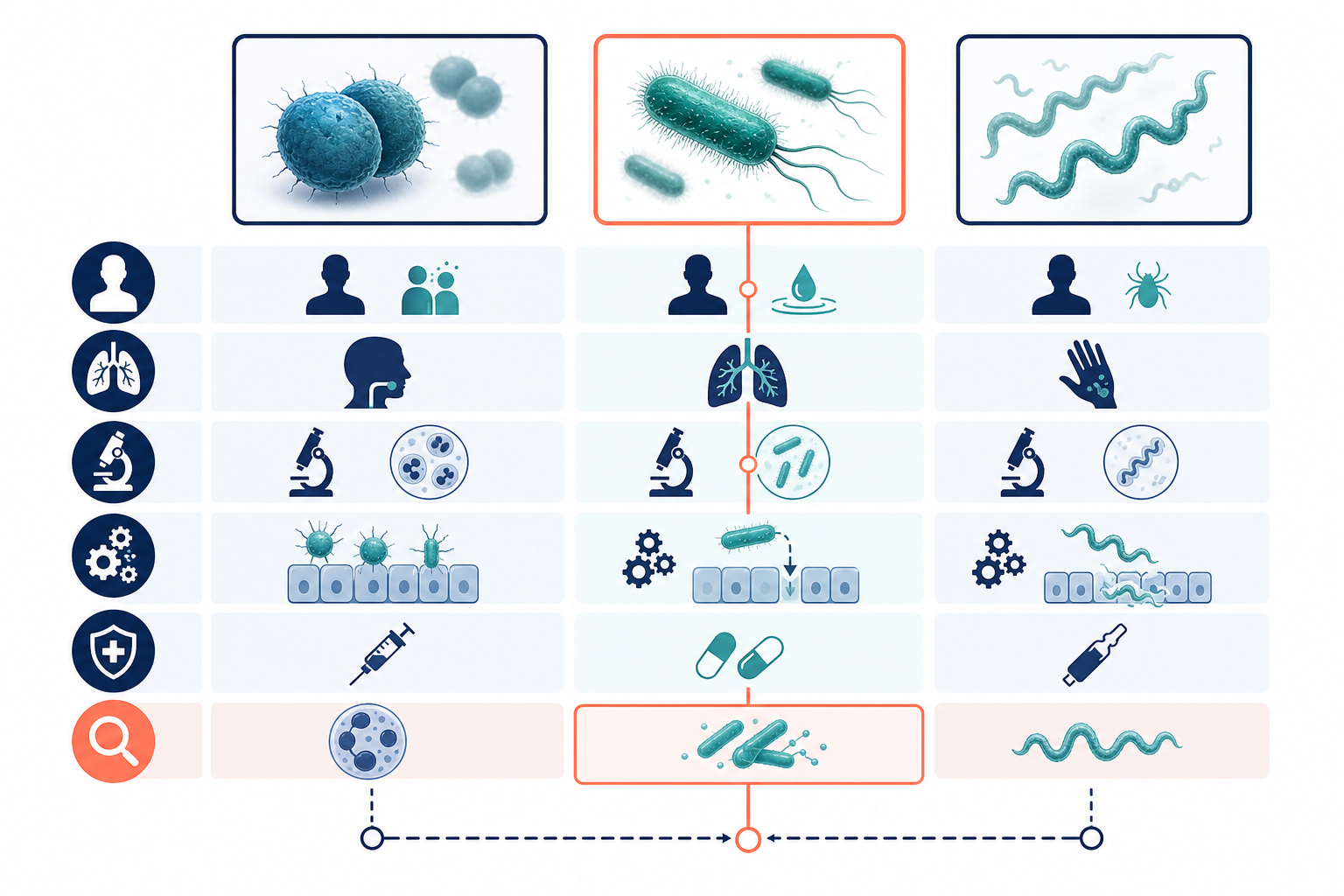
A useful matrix should reveal how your decision changes when one stem feature changes. Build it from questions you have actually encountered.
| Stem dimension | Organism A | Organism B | Organism C | Decision question | |---|---|---|---|---| | Typical host or exposure | Retrieve from memory | Retrieve from memory | Retrieve from memory | Which exposure is most specific? | | Anatomic pattern | Retrieve from memory | Retrieve from memory | Retrieve from memory | Does the organ pattern exclude one option? | | Laboratory or morphology clue | Retrieve from memory | Retrieve from memory | Retrieve from memory | Which result separates the closest pair? | | Mechanism | Retrieve from memory | Retrieve from memory | Retrieve from memory | Is the presentation driven by invasion, toxin, or host response? | | Management implication | Retrieve from memory | Retrieve from memory | Retrieve from memory | Would identifying the organism change treatment or prevention? | | Best discriminator | One short phrase | One short phrase | One short phrase | What would make the answer flip? |
Initially, fill the matrix using a reliable microbiology resource. After that, cover the organism columns and reconstruct them from the row prompts. On later reviews, reverse the task: read one feature and name the organism it favors.
This bidirectional retrieval matters because stems can approach the same organism from different directions. One question may begin with an exposure; another may begin with a stain, complication, or mechanism.
Use a four-pass comparison workflow
A focused session can fit into 45 to 60 minutes.
Pass 1: Construct one set for 10 minutes
Choose two to four confusable organisms. Draft the matrix from memory before checking a source. Mark uncertain cells rather than immediately looking them up.
Pass 2: Answer 8 to 12 mixed questions for 20 minutes
Use timed or lightly timed questions once you know the basic content. Before selecting an answer, state the leading two organisms and the clue separating them. This adds only a few seconds but prevents reflexive pattern matching.
Pass 3: Perform contrastive review for 15 minutes
For each miss or guess, record:
- target organism;
- closest competitor;
- pivot clue;
- error type; and
- one “choose X over Y when…” rule.
Guessed-correct questions belong in this review. The goal is reliable reasoning, not credit for a fortunate selection.
Pass 4: Finish with closed-book retrieval for 5 minutes
Put away the chart. Reproduce the best discriminator for every pair in the set. End by creating one miniature stem that would favor each organism.
A study found that interactive retrieval practice in medical physiology was associated with better performance on relevant customized national examination questions. That study did not test this microbiology workflow specifically, so it should support the retrieval principle—not a claim that one exact schedule is universally optimal.
Schedule retrieval before the distinctions fade
The intervals below are a practical starting schedule, not an official USMLE requirement. Shorten them for unstable material and lengthen them when retrieval is consistently fast and accurate.
| Checkpoint | Task | Advance when… | If unsuccessful… | |---|---|---|---| | Same day | Rebuild the set without notes | You recall each best discriminator | Correct the matrix and retest in 10 minutes | | 1 day later | Answer pairwise prompts and two mini-stems | You identify the target and explain why its competitor is wrong | Repeat the set the next day | | 3 days later | Mix the set with a second confusion set | You maintain accuracy without relying on topic order | Reduce the set to the two organisms still colliding | | 7 days later | Complete a mixed microbiology block | You use the discriminator under time pressure | Extract new pivot clues from missed stems | | 14 days later | Retrieve from a blank page or oral drill | Responses are accurate and prompt | Return to a 3-day interval | | 30 days later | Test within a multidisciplinary block | The distinction survives without microbiology cues | Keep it in periodic mixed review |
Research involving interleaved science quizzes found stronger delayed performance for interleaved retrieval than for blocked retrieval in that setting. The study of interleaved retrieval practice was not conducted with USMLE learners, but it supports mixing related categories after initial learning rather than repeatedly practicing one organism in isolation.
Measure progress by discrimination, not chart completion
A finished chart is not a meaningful endpoint. Use checkpoints that reflect what must happen during an exam question.
Track four measures each week:
- **Pairwise accuracy:** Can you distinguish each organism from its nearest competitor?
- **Discriminator latency:** Can you produce the deciding feature within about 10 seconds?
- **Novel-stem transfer:** Can you apply the distinction when the wording or entry clue changes?
- **Error recurrence:** Does the same organism pair continue to generate misses or guesses?
A set is provisionally stable when you can retrieve its key contrasts on two separate days and apply them in mixed questions. It is exam-ready when the same distinctions survive timed, multidisciplinary blocks.
Use a simple red-yellow-green status:
- **Red:** You cannot name the closest competitor or discriminator.
- **Yellow:** You know the contrast after prompting but hesitate in stems.
- **Green:** You identify and justify the answer rapidly in mixed questions.
Spend most comparison time on red and yellow sets. Green sets still need periodic retrieval, but they should not consume the same daily attention.
Fix the failure modes that make comparison practice inefficient
**Your sets are too large.** If a chart contains 15 organisms, divide it by syndrome, morphology, exposure, or host status. Compare locally before integrating globally.
**You are copying instead of retrieving.** Draft first from memory. Check second. Correct third. A neat chart built while looking at a reference may produce little usable recall.
**Every detail appears equally important.** Limit each organism to a few high-value clues and one best discriminator. Add a fact only if it has changed—or could plausibly change—an answer.
**You memorize buzzwords without reading the full stem.** Require two supporting features before committing. Then ask whether any finding contradicts your leading diagnosis.
**You review only missed questions.** Include uncertain correct answers and slow correct answers. Both reveal fragile discrimination that may fail under pressure.
**Interleaving becomes overwhelming.** Establish basic organism profiles before mixing several sets. Difficulty can support learning, but confusion without a foundation is not productive practice.
**You keep repeating familiar pairs.** Let error recurrence determine priority. If one pair remains green while another repeatedly collapses, shift retrieval volume to the unstable pair.
Final takeaways
- Organize microbiology around small sets of organisms you could realistically confuse.
- Extract the pivot clue from question stems and write “choose X over Y when…” rules.
- Retrieve comparisons in both directions instead of rereading completed charts.
- Space reviews across days, then test the distinctions in mixed, timed blocks.
- Advance a set only when its discriminators remain usable in unfamiliar stems.
Turn your next weak organism pair into a focused comparison session: Build your next study block with CoreStepPrep.