Loperamide Mechanism, Uses, and Toxicity | USMLE
Learn loperamide’s gut-selective μ-opioid mechanism, safe diarrhea use, red-flag contraindications, overdose cardiotoxicity, and USMLE clues.
Loperamide is easy to recognize as an antidiarrheal but easy to misuse on an exam question. The practical rule is simple: **use it to slow uncomplicated watery diarrhea, not a colon that is inflamed, invaded, obstructed, or dilated**.
Its pharmacology explains both sides of that rule. Loperamide activates peripheral μ-opioid receptors in the enteric nervous system, reducing propulsion and secretion. At recommended doses, P-glycoprotein efflux and extensive first-pass metabolism limit exposure to the brain. The patient gets an opioid-like effect in the bowel—slower transit—without the expected analgesia, euphoria, or respiratory depression of a centrally acting opioid.
That therapeutic separation can fail in massive overdose. At extreme exposure, loperamide can produce opioid toxicity and directly block cardiac ion channels, creating a distinctive combination of CNS depression, QRS widening, QT prolongation, and ventricular dysrhythmias.
How loperamide slows diarrhea without acting like morphine

Loperamide is a **peripherally acting μ-opioid receptor agonist**. Its principal clinical action occurs in the myenteric plexus, where opioid signaling suppresses enteric neurotransmission.
μ receptors are Gi-coupled. Their activation decreases adenylyl cyclase activity and intracellular cAMP, reduces presynaptic calcium-dependent neurotransmitter release, and decreases excitatory cholinergic signaling. The resulting bowel effects include:
- Reduced propulsive peristalsis
- Longer intestinal transit time
- Decreased intestinal fluid secretion
- More time for absorption of water and electrolytes
- Reduced stool frequency, urgency, and liquidity
A review of loperamide pharmacology describes its action primarily at myenteric μ receptors, with decreased peristalsis and secretion leading to prolonged transit time (PubMed review of loperamide cardiotoxicity and pharmacology).
The critical limitation is that loperamide treats the **symptom**, not the cause. It does not eradicate a pathogen, neutralize a toxin, suppress inflammatory bowel disease, or correct malabsorption. If the underlying disease requires specific treatment, slowing the bowel cannot substitute for it.
| Pharmacologic feature | Board-relevant consequence | |---|---| | Peripheral μ-receptor agonism | Decreases intestinal propulsion and secretion | | Gi-coupled signaling | Decreases cAMP and presynaptic neurotransmitter release | | Longer transit time | Increases water and electrolyte absorption | | No antimicrobial or anti-inflammatory action | Improves stool frequency without treating the cause |
Why therapeutic doses have minimal CNS effects
Loperamide is an avid substrate of **P-glycoprotein**, also called ABCB1 or MDR1. At the blood–brain barrier, this ATP-dependent transporter exports loperamide away from the CNS. Low systemic exposure from extensive intestinal and hepatic first-pass metabolism adds a second layer of peripheral restriction.
This is why a standard-dose patient generally does not experience clinically significant analgesia, euphoria, sedation, or respiratory depression. A review of human interaction studies found insufficient evidence that P-glycoprotein inhibition reliably causes clinically important CNS opioid toxicity when loperamide is taken at recommended doses (human evidence on loperamide and P-glycoprotein inhibition).
For Step 1, connect the barriers to the phenotype:
**Enteric μ agonism → constipation-like antidiarrheal effect** **P-glycoprotein plus first-pass metabolism → minimal brain effect**
Loperamide is metabolized mainly by CYP3A and CYP2C8 and undergoes intestinal P-glycoprotein efflux. A 2026 pharmacokinetic analysis modeled increased exposure with inhibitors of these pathways, including itraconazole, ritonavir, gemfibrozil, and quinidine (2026 pharmacokinetic analysis of loperamide interactions). The exam-level lesson is not to memorize every interaction. It is to recognize that transporter and metabolic inhibition can increase exposure, especially when combined with excessive dosing.
Choosing loperamide by the diarrhea phenotype
Loperamide is most appropriate when diarrhea is **watery, uncomplicated, nonbloody, and not accompanied by fever or systemic toxicity**. Rehydration remains the foundation of care because an antimotility drug does not replace lost fluid or electrolytes.
The CDC Yellow Book lists loperamide as an option for mild traveler’s diarrhea and as monotherapy or adjunctive therapy for moderate disease. It specifically advises against antimotility monotherapy when diarrhea is bloody or accompanied by fever (CDC Yellow Book guidance on traveler’s diarrhea).
| Clinical presentation | Loperamide decision | Reasoning | |---|---|---| | Afebrile, nonbloody watery diarrhea | Reasonable for symptom control | Low suspicion for invasive or severe inflammatory disease | | Mild or moderate noninvasive traveler’s diarrhea | Reasonable | May reduce frequency and urgency | | Appropriate antibiotic treatment already started | May be used as an adjunct in selected cases | Provides symptom relief while the antibiotic treats susceptible bacteria | | Grossly bloody stool | Do not use as reflexive monotherapy | Suggests invasive infection or significant mucosal inflammation | | Diarrhea with fever or systemic toxicity | Avoid monotherapy and evaluate | Symptomatic slowing does not address potentially invasive disease | | Acute severe ulcerative colitis | Avoid | Reduced motility can worsen colonic dilation | | Ileus, marked distention, or suspected toxic megacolon | Contraindicated | Further suppression of propulsion can contribute to deterioration or perforation | | Suspected severe *Clostridioides difficile* colitis | Avoid routine antimotility treatment | Concern for severe colitis, toxin retention, and colonic dilation |
The safest Step 2 CK approach is to screen for red flags before reaching for an antidiarrheal:
- Blood in the stool
- Fever or systemic toxicity
- Severe or progressive abdominal pain
- Abdominal distention or absent bowel function
- Peritoneal findings
- Acute severe inflammatory bowel disease
- Recent antibiotic exposure with concern for *C. difficile*
- Clinically important dehydration
- Symptoms that persist or worsen despite short-term self-treatment
Toxic megacolon is not simply “a lot of diarrhea.” It involves severe colonic dilation accompanied by systemic toxicity and can complicate infectious or inflammatory colitis. Published case literature has associated loperamide administration during *C. difficile* colitis with toxic megacolon (case report of loperamide-associated toxic megacolon).
The mechanism-based danger is straightforward: slowing transit is useful when rapid transit is the problem. It is hazardous when the colon is severely inflamed, functionally obstructed, or already dilated.
Dosing and routine adverse effects
For adult acute diarrhea, a commonly tested regimen is **4 mg initially, followed by 2 mg after each loose stool**, while observing the formulation-specific daily maximum. The FDA identifies maximum approved adult doses of **8 mg per day for OTC use** and **16 mg per day for prescription use**. Patients taking OTC loperamide should stop and contact a healthcare professional if diarrhea lasts more than two days (FDA loperamide dosing and packaging safety communication).
Routine adverse effects are extensions of reduced intestinal propulsion:
- Constipation
- Abdominal cramping or discomfort
- Nausea
- Abdominal distention
- Ileus with excessive motility suppression
For an exam vignette, new distention or constipation after loperamide is a reason to stop the drug, not escalate it. Persistent diarrhea with fever, blood, dehydration, or worsening pain similarly redirects the clinician toward diagnostic evaluation and treatment of the underlying condition.
High-dose toxicity changes the pharmacology
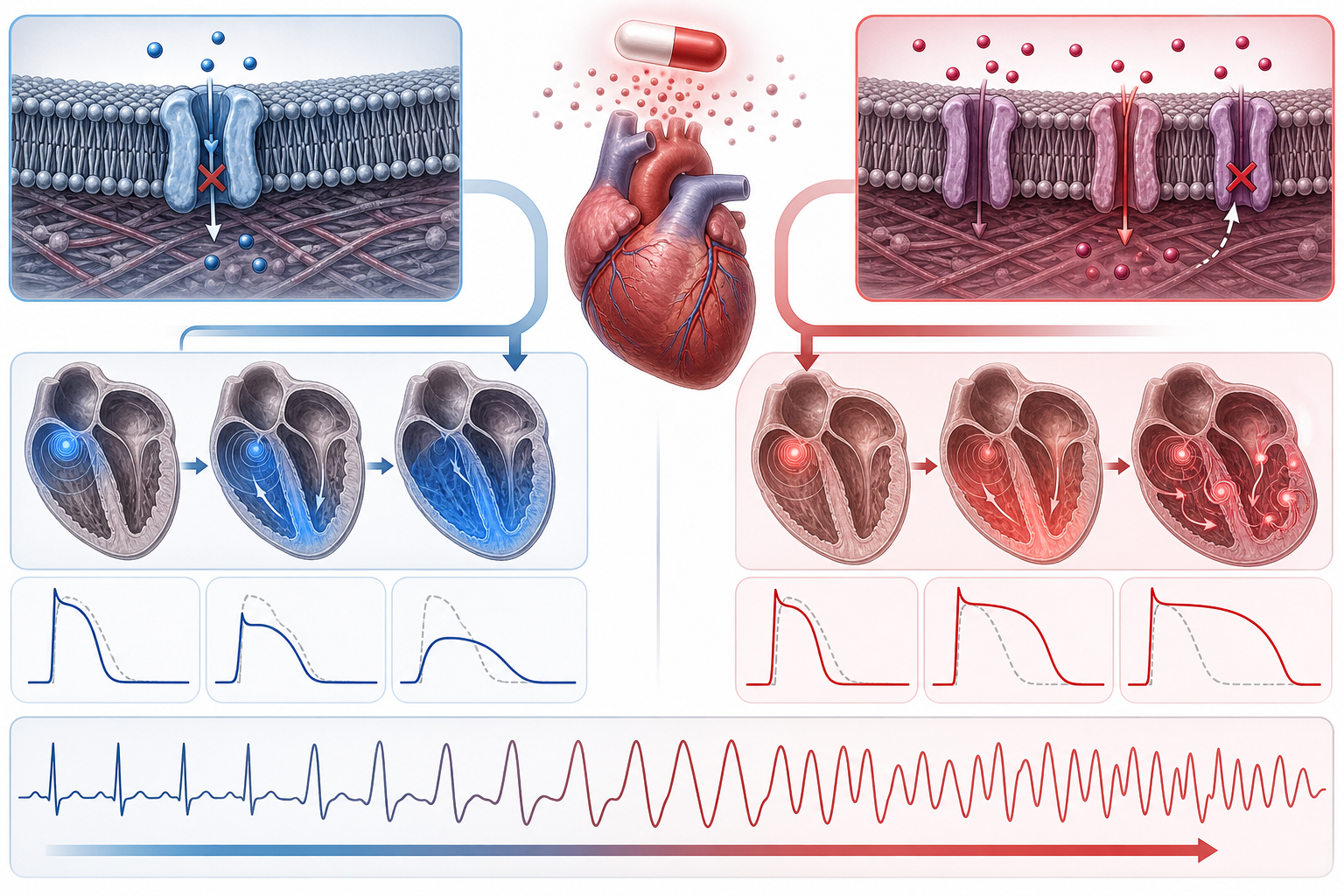
Massive doses can overwhelm the mechanisms that normally keep loperamide peripheral. Patients may take excessive quantities in an attempt to produce euphoria or suppress opioid withdrawal symptoms. At these exposures, two different toxic processes may appear.
First, CNS opioid effects can include miosis, sedation, decreased consciousness, and respiratory depression. Second—and often more dangerous—loperamide directly interferes with cardiac ion channels.
| Toxic target or effect | Expected finding | |---|---| | Central μ-opioid activity | Miosis, sedation, respiratory depression | | Nav1.5 sodium-channel blockade | Conduction slowing and QRS widening | | hERG potassium-channel blockade | QT prolongation and torsades de pointes risk | | Combined electrophysiologic toxicity | Bradycardia, ventricular tachycardia, syncope, cardiac arrest |
Experimental electrophysiology demonstrates inhibition of cardiac Nav1.5 sodium channels and hERG potassium channels, explaining the combination of QRS and QT prolongation (study of loperamide’s proarrhythmic ion-channel mechanisms). The FDA has also reported QT prolongation, torsades de pointes, other ventricular arrhythmias, syncope, cardiac arrest, and death with doses far above recommendations.
Suspected overdose requires immediate discontinuation, an ECG, continuous cardiac monitoring, correction of electrolyte abnormalities, and toxicology-guided supportive care. Naloxone may improve respiratory or neurologic opioid effects, but it does not reverse direct sodium- or potassium-channel blockade. Refractory dysrhythmias may require electrical pacing, cardioversion, or defibrillation (review of loperamide misuse and toxicity management).
The board trap is attributing every overdose manifestation to μ-receptor stimulation. **Naloxone treats opioid physiology; it does not remove loperamide from cardiac ion channels.**
Loperamide versus diphenoxylate–atropine
Both drugs decrease intestinal motility through opioid mechanisms, but loperamide is more effectively excluded from the CNS at therapeutic doses. Diphenoxylate is combined with atropine to discourage excessive dosing by producing unpleasant antimuscarinic effects.
| Feature | Loperamide | Diphenoxylate–atropine | |---|---|---| | Routine access | OTC and prescription products | Prescription combination | | CNS penetration at therapeutic doses | Minimal | Greater than loperamide | | Deterrent ingredient | None | Atropine | | Major overdose pattern | Opioid effects plus QRS/QT abnormalities | Opioid respiratory depression, sometimes with antimuscarinic findings |
In diphenoxylate–atropine overdose, opioid CNS and respiratory depression may predominate, while atropine can add fever, flushed dry skin, hypertension, agitation, or other antimuscarinic findings (review of diphenoxylate–atropine overdose).
The shared clinical rule matters more than the comparison: neither medication should be selected reflexively for bloody, febrile, severely inflammatory, or distention-associated diarrhea.
Exam-style vignette: separate therapeutic action from toxicity
A 29-year-old man with opioid use disorder is brought to the emergency department after syncope. He is somnolent and bradycardic with pinpoint pupils. ECG shows a widened QRS complex and a markedly prolonged QT interval. His roommate reports that the patient has been consuming large quantities of an OTC antidiarrheal to manage withdrawal symptoms. Naloxone improves his respiratory rate, but the ECG abnormalities persist.
**What is the most likely explanation for the persistent cardiac findings?**
The drug is loperamide. Its therapeutic action is peripheral μ-opioid receptor agonism in the gut, while P-glycoprotein ordinarily limits CNS penetration. Massive exposure can produce central opioid toxicity, explaining the miosis and respiratory depression that improve with naloxone.
The persistent ECG abnormalities arise from a separate mechanism: direct blockade of cardiac sodium and hERG potassium channels. Sodium-channel blockade widens the QRS; hERG blockade prolongs the QT and increases the risk of torsades de pointes. Naloxone cannot reverse either ion-channel effect.
If the same vignette instead described an afebrile traveler with nonbloody watery diarrhea, normal vital signs, and no significant abdominal tenderness or distention, short-term loperamide for symptom relief would be reasonable alongside hydration.
Final takeaways
- Loperamide activates **peripheral μ-opioid receptors in the myenteric plexus**, reducing propulsion and secretion.
- **P-glycoprotein efflux and extensive first-pass metabolism** explain its minimal CNS effects at recommended doses.
- Use it for selected **nonbloody, afebrile, uncomplicated watery diarrhea**, while prioritizing fluid and electrolyte replacement.
- Avoid reflexive antimotility treatment in bloody or febrile diarrhea, severe colitis, ileus, marked distention, or suspected toxic megacolon.
- In overdose, remember **μ toxicity plus Nav1.5 and hERG blockade**: naloxone may improve respiratory depression but not the dysrhythmia.
Build your next study block with CoreStepPrep.
Sources and further reading
- pubmed.ncbi.nlm.nih.gov/29125226
- pubmed.ncbi.nlm.nih.gov/20604828
- pubmed.ncbi.nlm.nih.gov/41563903
- www.cdc.gov/yellow-book/hcp/preparing-international-travelers/travelers-diarrhea.html
- pubmed.ncbi.nlm.nih.gov/2217023
- www.fda.gov/files/FDA-limits-packaging-for-anti-diarrhea-medicine-loperamide-%28Imodium%29-to-encourage-safe-use_PDF.pdf
- pubmed.ncbi.nlm.nih.gov/27530870
- pubmed.ncbi.nlm.nih.gov/31116446
- pubmed.ncbi.nlm.nih.gov/2020516