Final Two Weeks Before Step 2 CK: Decision Plan
Use your final two weeks before Step 2 CK to sharpen next-best-step decisions, repair recurring errors, build stamina, and prepare for test day.
The final two weeks before Step 2 CK are not the time to prove how many questions you can complete. They are the time to make your clinical decisions faster, cleaner, and more consistent.
Your highest-value work now is to practice choosing the next best step under timed conditions, identify why your decisions fail, and repair only the errors likely to recur. That means shifting away from broad content accumulation and toward mixed timed blocks, decision-focused review, realistic stamina practice, and test-day preparation.
The goal is not to know everything by exam day. It is to reliably convert the knowledge you already have into the best available answer.
Why the final two weeks should prioritize decisions
Step 2 CK questions often require more than naming a diagnosis. You may need to choose the next diagnostic test, immediate stabilization step, definitive treatment, preventive intervention, or appropriate disposition. Several options may be medically reasonable, but only one fits the patient’s current position in the clinical sequence.
That makes the final two weeks especially valuable for improving **decision structure**. Instead of asking only, “What disease is this?” train yourself to ask:
- Is the patient stable or unstable?
- What decision is the question actually requesting?
- Has the diagnosis already been established?
- Is an immediate intervention required before further testing?
- If the patient is stable, what is the least invasive appropriate next step?
- Which option changes management now?
This workflow is a practical recommendation, not an official USMLE algorithm. Use it to organize your reasoning, then verify that you are practicing the tested content and interfaces described in the official USMLE Step 2 CK preparation materials. Those materials include the content outline, sample questions, question-format guidance, and an interactive testing experience.
A useful final-phase rule is: **review the decision, not merely the disease**. If you miss a pulmonary embolism question because you selected CT angiography before stabilizing a severely compromised patient, rereading an entire pulmonary chapter may not fix the problem. You need to repair the unstable-patient branch of your decision process.
Build every study day around mixed timed practice
Mixed timed blocks should become the center of your schedule because they force you to switch among specialties, identify the task without advance cues, and commit to answers under pressure. A subject-specific block can confirm that you recognize cardiology patterns. A mixed block tests whether you recognize that the question is cardiology at all—and whether you can distinguish diagnosis from management.
For most learners, one or two serious mixed blocks with high-quality review are more valuable than several rushed blocks followed by superficial explanation reading. The exact question count should depend on your available time, fatigue, and review speed. Preserve enough attention to analyze the decisions you made.
Use this three-stage workflow:
Before the block: define one process target
Choose a narrow behavior to monitor. Examples include:
- Identify stability before examining answer choices.
- State the requested task in five words or fewer.
- Avoid changing answers without new evidence from the stem.
- Move on when time spent exceeds your preset limit.
- Distinguish the best initial test from the most accurate test.
Do not carry five process goals into one block. One visible target is easier to measure.
During the block: use a brief decision pause
Before selecting an answer, complete this sentence mentally:
“This patient is ___, and the question wants ___, so the next step is ___.”
For example: “This patient is hemodynamically unstable, and the question wants immediate management, so the next step is stabilization rather than confirmatory imaging.”
The pause should take seconds, not become a long internal monologue. Its purpose is to prevent reflex answers based on one familiar clue.
After the block: classify errors before reviewing content
Label each incorrect, guessed, or excessively slow question with one primary cause:
- **Knowledge gap:** You did not know the relevant fact or guideline.
- **Recognition gap:** You knew the concept but failed to identify it in the vignette.
- **Sequencing error:** You chose a reasonable action at the wrong point in care.
- **Task error:** You answered diagnosis when the question asked management, prognosis, prevention, or another task.
- **Evidence-weighting error:** You overvalued a vivid clue and ignored stronger evidence.
- **Timing error:** You rushed, perseverated, or failed to return to a flagged item efficiently.
This classification determines the repair. A knowledge gap may require targeted content review. A sequencing error requires comparing the steps in order. A timing error requires a behavioral rule and another timed trial—not another hour of reading.
Use a decision-first error repair loop
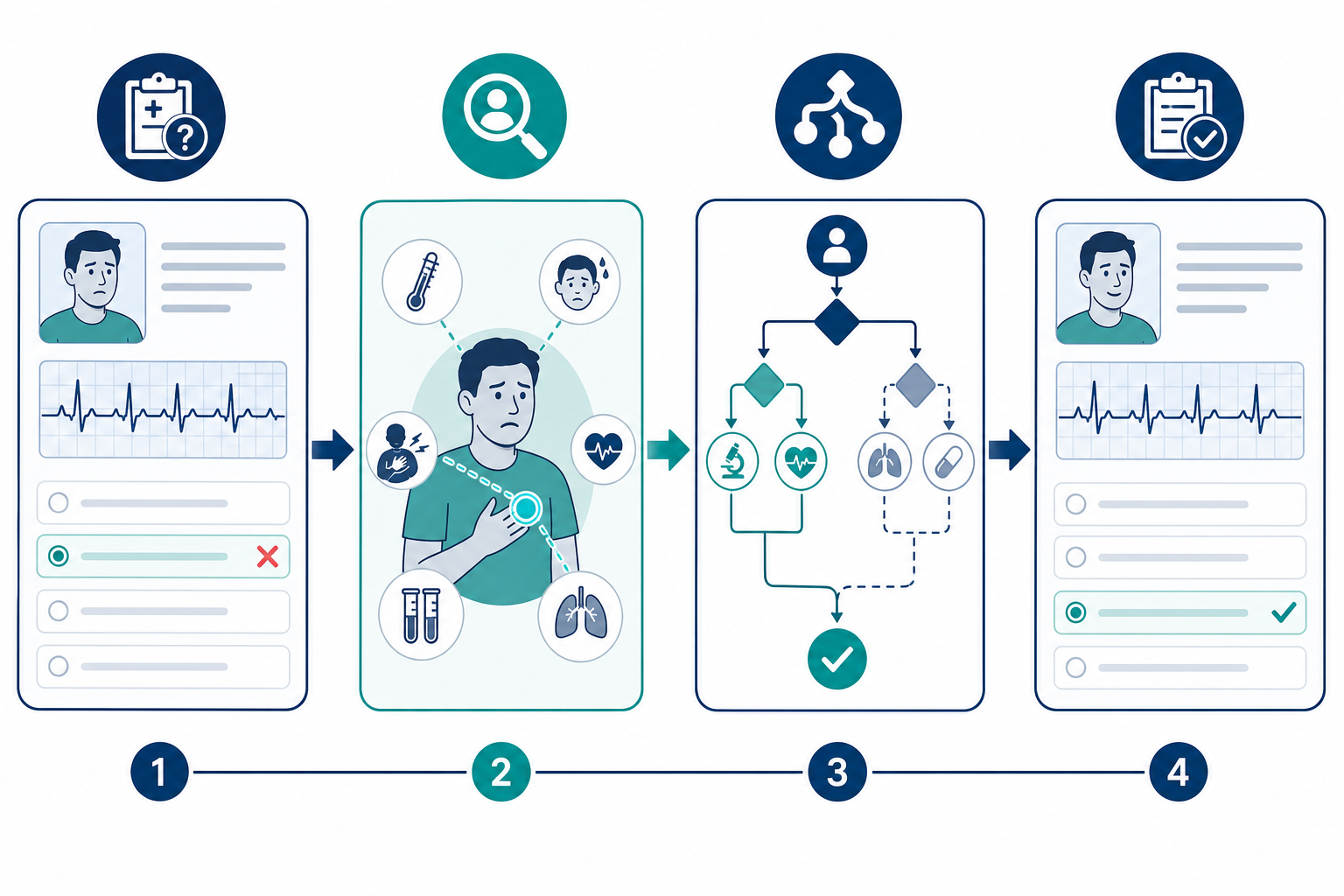
Your error log should become shorter and more useful during the final two weeks. Avoid copying long explanations or building a new encyclopedia. Record only what can change a future answer.
For each high-value error, write four lines:
- **Trigger:** What feature should have activated the correct pathway?
- **Task:** What was the question asking you to decide?
- **Rule:** What compact principle separates the correct answer from the distractor?
- **Next variation:** How might the same decision appear with different demographics or findings?
Example:
- **Trigger:** Fever, hypotension, altered mental status, and suspected infection.
- **Task:** Immediate management.
- **Rule:** Treat instability and time-sensitive threats before pursuing lower-priority diagnostic refinement.
- **Next variation:** The source may change, but shock physiology still controls the sequence.
Prioritize repairs that meet at least one of these criteria:
- The same error has appeared more than once.
- The concept affects several organ systems.
- The miss involved stability, urgency, or sequencing.
- You were torn between two answers you commonly confuse.
- The question consumed disproportionate time.
Deprioritize isolated trivia unless it belongs to a recurring pattern. The final two weeks reward recurrence prevention more than exhaustive note expansion.
A realistic 14-day Step 2 CK schedule
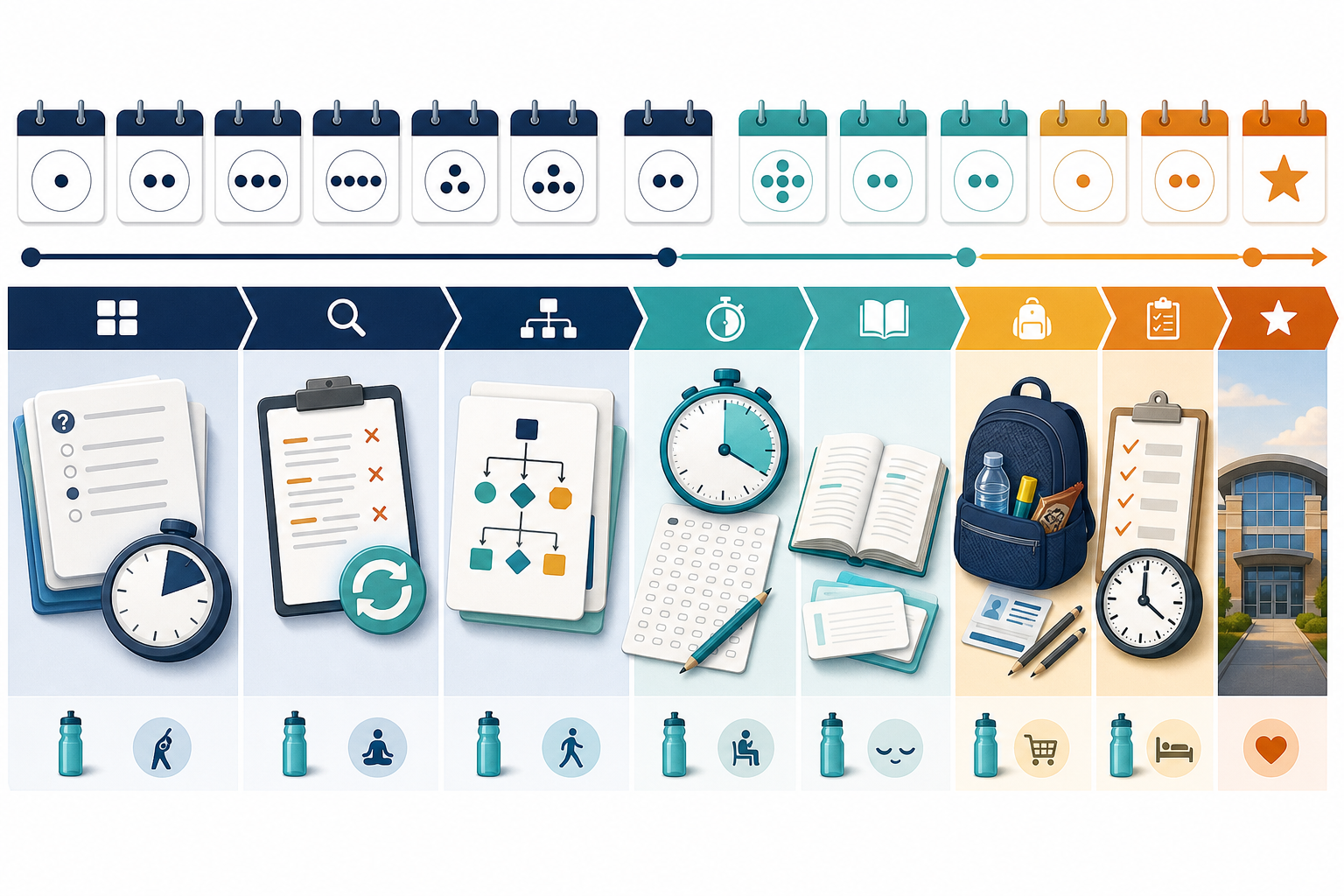
This schedule is a practical model, not an official USMLE prescription. Adjust block volume to your baseline, accommodations, clinical responsibilities, and fatigue. Keep the sequence: diagnose your patterns, repair them, rehearse sustained performance, then taper.
| Days remaining | Primary work | Review emphasis | Readiness objective | |---|---|---|---| | 14–12 | Mixed timed blocks plus a recent self-assessment or existing performance report | Classify errors and identify three recurring decision failures | Establish a narrow priority list | | 11–9 | Mixed timed blocks with targeted repair between blocks | Next-step sequencing, unstable patients, screening/prevention, and recurring weak systems | Demonstrate fewer repeated errors | | 8–7 | Longer timed session using realistic breaks and food | Track late-session timing, attention, and decision quality | Test stamina and logistics | | 6–5 | Mixed timed work at normal pace; revisit only high-value error sets | Compare commonly confused actions and tests | Improve consistency without increasing resources | | 4–3 | Final substantial rehearsal or assessment, followed by selective review | Separate correctable process misses from isolated surprises | Confirm readiness and finalize pacing rules | | 2 | Light mixed practice or selected official sample material | Review compact rules, not entire subjects | Preserve confidence and normal sleep | | 1 | Minimal academic work; prepare documents, route, food, clothing, and alarms | Briefly review personal process reminders only | Arrive rested and organized | | Exam day | Execute familiar pacing, break, hydration, and reset routines | Treat each block as a fresh task | Protect decision quality across the full day |
Do not schedule a major new resource during this period. If a tool, book, or video series has not already earned a role in your preparation, it should not displace timed application and error repair now.
Check progress by measuring repeat errors
Raw percentage correct can fluctuate with question difficulty and topic distribution. Track process indicators alongside performance.
At the end of days 10, 6, and 3, review these checkpoints:
Decision accuracy
- Are you correctly identifying whether the question asks for diagnosis, testing, treatment, prevention, prognosis, or disposition?
- Are you making fewer stability and sequencing errors?
- Are your changed answers based on evidence rather than discomfort?
Timing control
- Are you completing blocks without a chaotic final stretch?
- Can you leave a difficult item and return without carrying frustration forward?
- Are a few questions consuming time needed for the rest of the block?
Error recurrence
- Which errors appeared more than once this week?
- Did a targeted repair prevent the same miss in a new vignette?
- Is your error log becoming more concentrated around a few actionable patterns?
Stamina
- Does decision quality deteriorate late in a long session?
- Are missed questions later in the day due to knowledge, reading discipline, hunger, or attention?
- Does your planned break routine restore focus?
Progress does not require every metric to improve every day. You are looking for a directional change: fewer repeated process errors, steadier pacing, and better recognition of what the question requires.
Rehearse stamina without exhausting yourself
At least once before the final few days, complete a longer practice session that tests more than content. Use your intended wake time, breakfast, caffeine plan, clothing, break routine, and workstation habits. The purpose is to discover preventable problems while there is still time to correct them.
During this rehearsal, record when you experience:
- A noticeable drop in reading accuracy.
- Impulsive answer selection.
- Repeated rereading without gaining clarity.
- Hunger, thirst, headache, or restlessness.
- Difficulty resetting after a challenging block.
Then modify the routine. If attention falls after several blocks, test a more deliberate break. If caffeine causes urgency or jitteriness, do not improvise with a larger dose on exam day. If you lose time early, set a checkpoint for your progress within each block.
Stamina practice should not become repeated self-exhaustion. One informative rehearsal followed by targeted adjustments is more useful than draining yourself every day.
Protect the final 48 hours from common failure modes
**Failure mode: Increasing question volume to suppress anxiety.** Repair: Set a fixed stopping time and judge the day by review quality, not question count.
**Failure mode: Reopening every weak subject.** Repair: Review only recurring, consequential errors. Broad insecurity is not a workable study target.
**Failure mode: Treating every miss as a knowledge deficit.** Repair: Classify the error first. Many late-stage misses come from task identification, sequencing, evidence weighting, or timing.
**Failure mode: Changing sleep, caffeine, or meals at the last minute.** Repair: Use the routine already tested during your stamina rehearsal.
**Failure mode: Letting one difficult block predict the exam.** Repair: Use a reset script: release the previous block, take care of physical needs, and begin the next block without attempting to estimate your score.
**Failure mode: Studying heavily the night before.** Repair: Stop early enough to prepare logistics and protect sleep. Last-minute overload is unlikely to repair a major weakness, but it can disrupt the routine you need to execute.
Final takeaways
- Make mixed timed blocks the center of the final two weeks, but protect enough time for decision-focused review.
- Classify misses before choosing a repair; not every incorrect answer requires more content study.
- Prioritize recurring errors involving stability, urgency, task identification, and next-step sequencing.
- Use checkpoints to monitor timing, repeat errors, and late-session decision quality—not only percentage correct.
- Taper during the final 48 hours so that test-day execution becomes the priority.
Turn these priorities into a focused daily plan: Build your next study block with CoreStepPrep.