Final Two Weeks Before Step 1: Consolidate
Use this focused 14-day Step 1 plan to consolidate knowledge, practice representative questions, protect sleep, and finalize test-day logistics calmly.
Two weeks before Step 1, the most dangerous thought is often: *I should start over and fix everything.*
That impulse is understandable—and usually counterproductive. Fourteen days is enough time to strengthen retrieval, correct recurring errors, rehearse exam-like decisions, and stabilize your daily routine. It is not enough time to rebuild your entire basic-science foundation without sacrificing sleep, confidence, or representative practice.
Your goal now is **consolidation**: make the knowledge you already possess easier to retrieve and apply under timed conditions. Use familiar resources, prioritize patterns that repeatedly cost you questions, and remove logistical uncertainty before test day.
Why Consolidation Is the Right Final-Two-Week Goal
Step 1 preparation can feel endless because every reviewed topic exposes another detail you could learn. In the final two weeks, however, completeness is the wrong target. Reliable execution is the right one.
Consolidation works because it narrows your work to four practical priorities:
- **Retrieval:** Can you recognize and apply information without searching through notes?
- **Discrimination:** Can you distinguish the best answer from plausible distractors?
- **Error correction:** Are you fixing recurring reasoning mistakes rather than merely collecting explanations?
- **Endurance:** Can you maintain your process across consecutive timed blocks?
The official USMLE Step 1 materials provide the content outline, sample questions, question-format guidance, and an interactive testing experience. Use those materials to confirm that your practice remains aligned with the exam rather than drifting toward increasingly obscure content.
This does not mean ignoring weaknesses. It means addressing weaknesses at the level that can still change your performance. For example, “relearn all of renal physiology” is too broad. “Correct my confusion between prerenal azotemia and acute tubular injury, then test it with mixed questions” is actionable.
Set Your Final Readiness Standard Before Anxiety Sets It for You
Before planning the next 14 days, define what evidence will tell you to maintain, reduce, or reconsider your workload. Do this while calm—not after one disappointing question block.
Your readiness standard should incorporate:
- Results from recent representative assessments
- The trend across multiple data points, not one isolated score
- Timed-block completion and pacing
- The types of errors you are still making
- Your ability to study and sleep without progressive deterioration
- Any readiness criteria established by your school or academic advisor
Avoid inventing a new score target during the final week. Use the threshold or decision process you established with your program, advisor, or prior plan. If you have not established one, contact an appropriate advisor early in this two-week window.
A useful distinction is whether missed questions reflect **repairable execution errors** or **unstable foundational knowledge**. Misreading a qualifier, changing a correct answer without evidence, or missing a familiar association may improve with focused correction. Consistently failing to identify the tested system, mechanism, or diagnosis across representative assessments deserves a more serious readiness discussion.
A 14-Day Consolidation Schedule

The following schedule is a practical recommendation, not an official USMLE prescription. Adjust question volume to your current capacity. The purpose is to preserve representative practice while progressively reducing cognitive overload.
| Time remaining | Primary objective | Representative work | Consolidation work | Recovery and logistics | |---|---|---|---|---| | Days 14–11 | Establish the final baseline | One to two timed mixed blocks on study days; complete a planned representative assessment if due | Categorize errors and select no more than three priority weaknesses | Fix wake time; confirm test date, location, travel, permit, and ID | | Days 10–7 | Repair recurring patterns | Timed mixed questions with deliberate pacing | Target the three selected weaknesses using familiar notes, questions, or flashcards | Maintain exercise, meals, and a consistent bedtime | | Days 6–4 | Rehearse execution | Complete your final planned assessment or longer simulation early enough to review it | Review recurring misses, equations, mechanisms, and high-frequency personal errors | Practice breakfast, caffeine, clothing, and break-food choices | | Days 3–2 | Taper without disengaging | One reduced-volume mixed set if it helps maintain rhythm | Review a compact error sheet and previously learned material only | Pack supplies, verify the route, and protect sleep | | Day 1 | Preserve readiness | No full assessment and no exhausting question marathon | Brief confidence review, then stop at a predetermined time | Prepare food and clothing; use a normal evening routine | | Test day | Execute the rehearsed process | Treat each block as a fresh task | Do not mentally review completed blocks | Follow your planned pacing, breaks, hydration, and nutrition |
If you have already completed the assessments in your plan, do not add another merely because the calendar says you should. More measurement is not automatically more preparation. Use remaining time to correct the errors your existing data have already revealed.
Build Each Study Day Around Questions, Correction, and Closure
A final-two-week study day should have a clear endpoint. One realistic structure is:
Morning: Timed representative practice
Complete one mixed, timed block under distraction-free conditions. If your endurance and readiness are stable, you may complete a second block after a short break. Use the same question source and interface you already know.
The block is not just a content quiz. Practice your complete decision process:
- Identify what the question is actually asking.
- Commit to a mechanism, diagnosis, or principle before scanning every option repeatedly.
- Eliminate answers for specific reasons.
- Mark only questions that genuinely deserve another look.
- Move on when additional time is unlikely to improve the decision.
Midday: Review decisions, not just facts
For each miss or uncertain correct answer, record the smallest useful lesson. Sort it into one of four categories:
- **Knowledge gap:** You did not know the required fact or mechanism.
- **Recognition gap:** You knew the concept but failed to identify its presentation.
- **Reasoning error:** You misinterpreted the stem or selected a less appropriate answer.
- **Process error:** Pacing, fatigue, overthinking, or answer-changing disrupted performance.
Then write one correction that can influence a future question. “Review cardiology” is not a correction. “When hypotension follows myocardial infarction with clear lungs, compare right ventricular infarction with left-sided pump failure” is specific enough to retrieve later.
Afternoon: One bounded repair session
Spend 60–120 minutes on one priority weakness using a resource you already understand. End with a small set of relevant questions or active recall. Passive rereading should not consume the entire session.
Stop when you have corrected the defined problem. Do not allow a missed question about one enzyme to become a four-hour reconstruction of an entire biochemical pathway.
Evening: Close loops and protect tomorrow
Use the final study period for a compact error list, mature flashcards, equations, or familiar diagrams. Set a firm stopping time. The purpose of the evening is to preserve retrieval—not to create enough new material to require another dedicated period.
Explicit Rules for What Not to Start
The final two weeks require a resource freeze. Unless an advisor identifies a specific exception, do **not** begin:
- A new comprehensive video course
- A new primary question bank
- A large premade flashcard deck
- A cover-to-cover reread of a review book
- A new note-taking or study-tracking system
- An obscure “last-minute high-yield” document from an unfamiliar source
- A major change in question strategy that you have not tested
- A new supplement, sleep aid, or aggressive caffeine routine
- Any source claiming to reproduce recalled or unauthorized exam content
You may use a new *small* resource when it solves a tightly defined problem—for example, one official tutorial to familiarize yourself with the testing interface. The rule is not “nothing new.” It is **no new system that creates more unfinished work than it resolves**.
Apply the same rule to flashcards. Continue cards that support stable recall, but do not chase an enormous daily backlog at the expense of questions, sleep, or targeted review. Suspend low-value cards rather than treating every scheduled repetition as equally important.
Checkpoint Rules for Adjusting Volume Without Panic
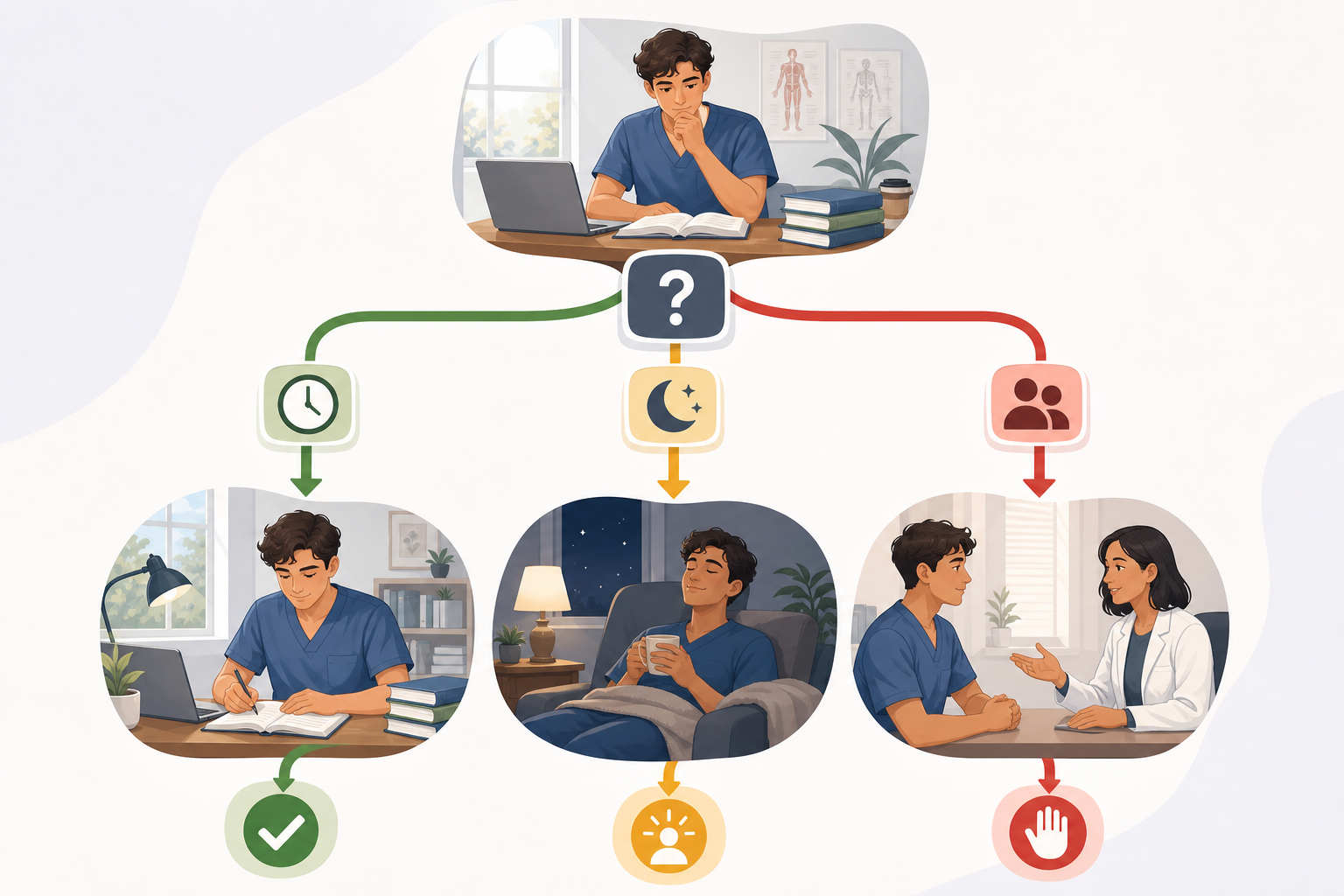
Evaluate your plan at Days 10, 6, and 3. Use trends and function rather than mood alone.
| Checkpoint status | What you are seeing | Appropriate adjustment | |---|---|---| | Green | Representative performance is consistent with your established readiness standard; timing is manageable; errors are becoming narrower | Maintain the plan. Do not increase volume simply because you feel nervous. | | Yellow | Performance is near your standard, but review backlogs, fatigue, rushed reading, or sleep disruption are increasing | Reduce question or review volume by roughly 20%–30% as a practical adjustment. Keep mixed timed practice and eliminate low-priority tasks. | | Red | Multiple representative data points remain below your established standard; timing is repeatedly collapsing; foundational misses remain broad; health or sleep is significantly deteriorating | Stop adding resources. Contact your school or advisor promptly, review official rescheduling requirements, and make a deliberate readiness decision. |
A yellow checkpoint is not a signal to study longer. It usually means the current workload is interfering with consolidation. Remove the least representative task first: excessive flashcard reviews, passive video hours, duplicate notes, or low-priority subject dives.
A red checkpoint should trigger a decision process, not a punishment cycle. An all-nighter or sudden doubling of question volume does not resolve uncertainty. The official USMLE exam-day checklist advises examinees to consider rescheduling if they feel unwell or unprepared. Any decision should account for your evidence, your advisor’s guidance, and the applicable scheduling rules.
Protect Sleep as Part of Exam Performance
Sleep is not leftover time after studying. It is one of the conditions under which you must retrieve and apply what you know.
The CDC states that adults ages 18–60 generally need at least seven hours of sleep and notes that adequate sleep supports attention and memory. Its guidance on healthy sleep also recommends consistent sleep and wake times, limiting afternoon or evening caffeine, and turning off electronic devices before bedtime.
For the final two weeks, use a practical sleep-stabilization plan:
- Wake at approximately the time required on exam day.
- Move bedtime gradually rather than attempting a dramatic shift the night before.
- Keep caffeine dose and timing familiar.
- End demanding study early enough to decompress.
- Avoid using the final evening to compensate for unfinished tasks.
- If you regularly struggle with sleep, seek appropriate medical guidance rather than experimenting with a new remedy immediately before the exam.
Do not judge the entire exam by one imperfect night of sleep. Your job is to create a stable pattern across the preceding days, not to force a flawless final night.
Remove Test-Day Logistics From Your Mental Workload
Logistical preparation prevents avoidable stress from competing with medical decision-making. Several days before the exam:
- Confirm the test center address and estimate travel time at the relevant hour.
- Decide when you will leave, including a delay buffer.
- Confirm that the name on your identification matches your scheduling permit.
- Save an accessible electronic copy of the permit and consider bringing a paper backup.
- Choose familiar food, water, clothing, and permitted personal items.
- Review the current rules for belongings, check-in, and breaks.
- Decide how you will respond if you feel unsettled after a difficult block.
USMLE instructs examinees to report approximately 30 minutes before the appointment and bring their scheduling permit plus acceptable, unexpired government-issued photo identification. Verify the complete current requirements through the official exam-day information rather than relying on another student’s memory.
Your final simulation should include more than questions. Rehearse waking, eating, beginning work, taking breaks, and restarting after a difficult block. The skill you are practicing is recovery: the next block must not become a referendum on the previous one.
Common Final-Two-Week Failure Modes
**Trying to eliminate every weakness:** You cannot make every topic equally strong. Prioritize repeated, consequential errors that appear in representative practice.
**Confusing activity with progress:** Ten hours of videos may feel productive while producing little evidence of improved retrieval. Keep timed questions and active correction at the center.
**Escalating after one poor block:** Review whether the block exposed a pattern. Do not redesign the schedule based on one noisy data point.
**Reviewing explanations without changing behavior:** Every important miss should produce a concise rule, comparison, or question-solving correction.
**Sacrificing sleep to finish a resource:** An unfinished resource is not a readiness failure. It is normal. Your performance depends on what you can retrieve, not whether every progress bar reached 100%.
**Using the final day as a rescue mission:** Set a stopping time before the day begins. Preparation should narrow as the exam approaches.
Final Takeaways
- Use the final two weeks to strengthen retrieval, correct recurring errors, and rehearse execution—not to rebuild your entire foundation.
- Freeze major resources and permit only small, targeted additions that solve a defined problem.
- Adjust workload using preplanned green, yellow, and red checkpoints rather than reacting to daily anxiety.
- Protect consistent sleep and complete test-day logistics early enough to identify problems.
- Arrive with a practiced process: one question, one block, and one recovery at a time.
Build your next study block with CoreStepPrep.