Build Illness Scripts From Missed USMLE Questions
Turn missed USMLE questions into concise illness scripts using comparison, mechanism checks, updates, and retrieval to strengthen clinical reasoning.
Missed clinical questions are most valuable when they change how you recognize the next case. If your review ends with highlighting an explanation or adding a long list of facts to flashcards, you may understand the question without repairing the reasoning that led you away from the answer.
A better approach is to convert selected misses into concise illness scripts: structured mental models that connect a disease’s setting, mechanism, expected findings, and distinguishing features. For USMLE Step 1, the script should preserve the basic-science chain that explains the presentation. For Step 2 CK, it should also clarify the diagnostic or management decision the vignette demands.
The goal is not to memorize a miniature textbook entry. It is to build a compact model you can compare, update, and retrieve under time pressure.
Why missed questions are ideal raw material for illness scripts
Illness scripts organize disease knowledge into networks that help learners interpret findings, compare competing diagnoses, and predict how a condition may present or evolve. Script theory also emphasizes that these networks are refined through repeated experience rather than acquired as finished summaries. A useful explanation of this framework is available in the peer-reviewed review on illness script formation and clinical reasoning.
A missed question exposes a specific weakness in that network. Common examples include:
- You did not activate the correct diagnosis from the opening clues.
- You recognized the diagnosis but could not explain the mechanism.
- You gave too much weight to a shared finding.
- You overlooked the clue separating two plausible options.
- You knew the disease but answered the wrong task, such as diagnosis instead of next management step.
This makes the missed question more useful than a generic disease review. It tells you exactly where your script failed.
There is educational evidence supporting the broader method, although it should not be overstated. In a randomized trial involving fourth-year medical students, illness-script instruction improved knowledge-test and script-concordance outcomes for the clinical scenarios studied, while the authors noted that generalization to real clinical settings required further investigation. That makes the randomized illness-script teaching trial supportive evidence—not proof that writing more scripts automatically produces a higher USMLE score.
**Evidence-backed principle:** Organized, retrievable disease models can support clinical reasoning.
**Practical recommendation:** Build scripts primarily from misses that reveal a recurring recognition, comparison, or mechanism problem. Do not create one for every incorrect question.
A concise illness script that preserves mechanistic reasoning
A useful USMLE illness script can usually fit in six lines. Each line has a distinct job:
- **Problem representation:** Compress the patient into age or risk context, time course, syndrome, and one or two defining findings.
- **Enabling conditions:** Record the exposures, physiology, medications, comorbidities, or demographic factors that change probability.
- **Mechanism:** State the causal chain from underlying process to major findings.
- **Expected consequences:** List only the manifestations and test patterns that follow from the mechanism.
- **Discriminators:** Identify the clues that separate this condition from its nearest competitor.
- **Decision point:** State the diagnosis, next test, treatment, or complication the question writer could ask you to choose.
Use this fill-in structure:
**Condition:**
**One-line presentation:**
**Why it happens:**
**What the mechanism predicts:**
**Most useful discriminator:**
**Likely USMLE decision:**
The mechanism line prevents pattern recognition from becoming superficial clue matching. If you write “Condition X causes finding Y,” ask one more question: *through what intermediate process?* Your answer does not need to include every molecular detail, but it should explain the high-yield relationship tested by the item.
For Step 1, that may mean connecting a mutation, receptor, enzyme, immune process, or physiologic change to the presentation. For Step 2 CK, it may mean connecting pathophysiology to disease severity, test selection, treatment, or an expected complication.
The missed-question-to-script workflow
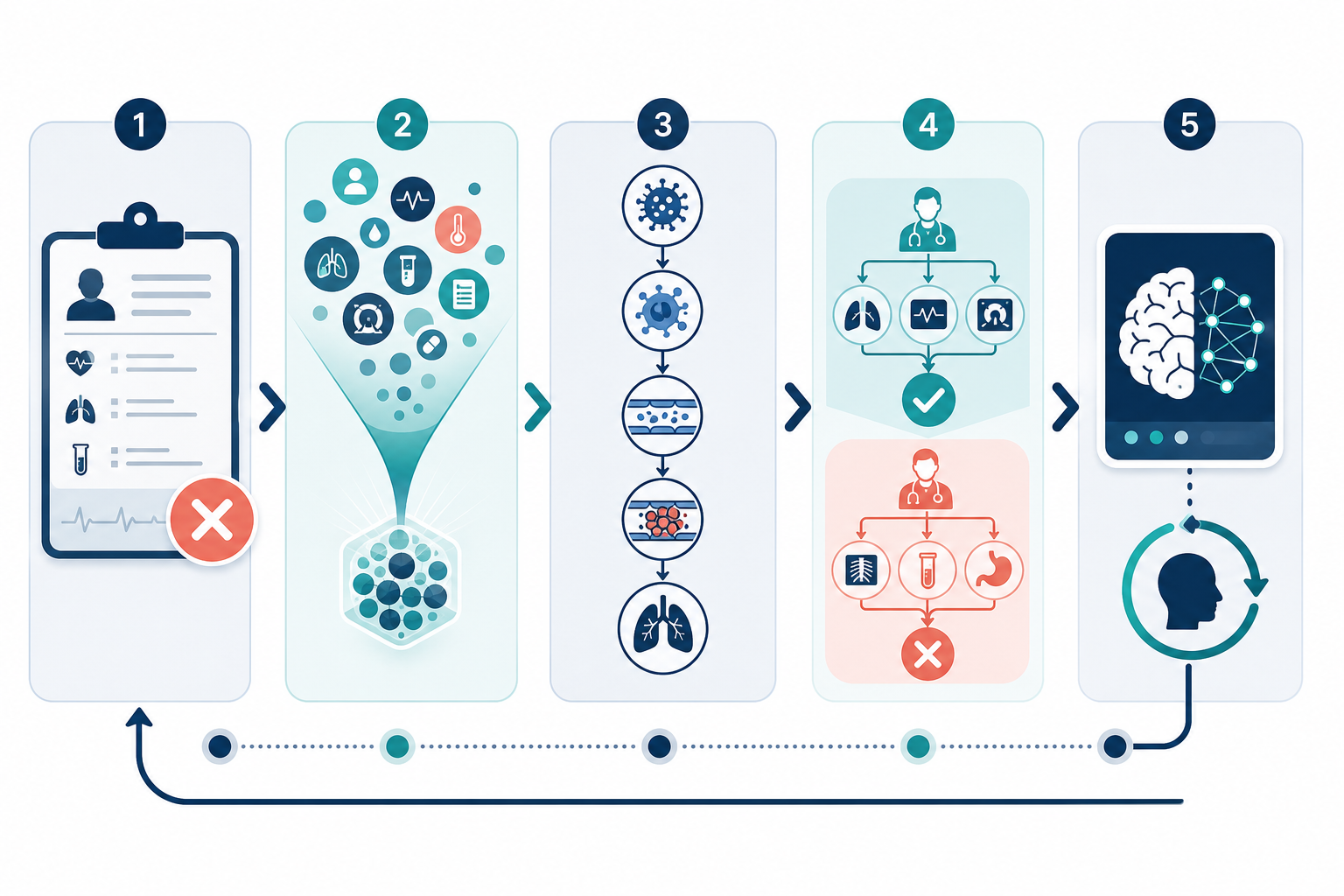
Use the following workflow immediately after a question block or during a dedicated review session.
1. Re-solve the question before reading the explanation
Hide the answer and produce three items from memory:
- a one-sentence problem representation;
- your leading diagnosis or next step;
- the clue that should decide between the top two options.
This separates a reasoning failure from a simple knowledge gap. If you cannot compress the stem, the problem may be poor clue prioritization. If you can identify the syndrome but not the disease, your comparison network may be weak. If you identify the disease but cannot justify the action, your management script needs repair.
2. Classify the reason for the miss
Choose one primary category rather than writing “didn’t know it.”
| Miss type | What probably needs repair | Script emphasis | |---|---|---| | Recognition failure | The disease was never activated | Enabling conditions and defining pattern | | Mechanism gap | Findings felt unrelated or arbitrary | Causal chain and predicted consequences | | Differential confusion | Two options seemed equally plausible | Paired discriminators | | Task error | You answered a different question than the one asked | Decision point and timing | | Memory failure | You previously knew the distinction | Retrieval cue and scheduled retesting | | Overinterpretation | You anchored on one dramatic clue | Whole problem representation and conflicting evidence |
This classification keeps review targeted. A missed management question does not necessarily require rewriting the entire disease presentation. A mechanism miss does not necessarily require five new cards about treatment.
3. Draft the script from memory
Write the six-line script before reopening your notes. Retrieval exposes what is genuinely available to you. Leave blanks where needed rather than filling them with guesses.
Then use the explanation or a trusted reference to correct those blanks. Mark additions with a symbol or different color so you can see what your original model lacked.
4. Add one contrast diagnosis
Write one sentence in this format:
**Condition A rather than Condition B because ___; if ___ were present instead, favor Condition B.**
The competitor should come from the question you missed, not from an exhaustive differential. This converts an isolated disease summary into a decision tool.
5. End with a retrieval prompt
Turn the script into a question that forces reconstruction rather than recognition. Examples include:
- “What mechanism links this risk factor to these findings?”
- “Which clue most strongly separates A from B?”
- “What changes the next step from testing to immediate treatment?”
- “Which expected result would contradict my leading diagnosis?”
One strong prompt is usually more valuable than ten cards copied from the explanation.
Compare scripts in pairs, not isolation
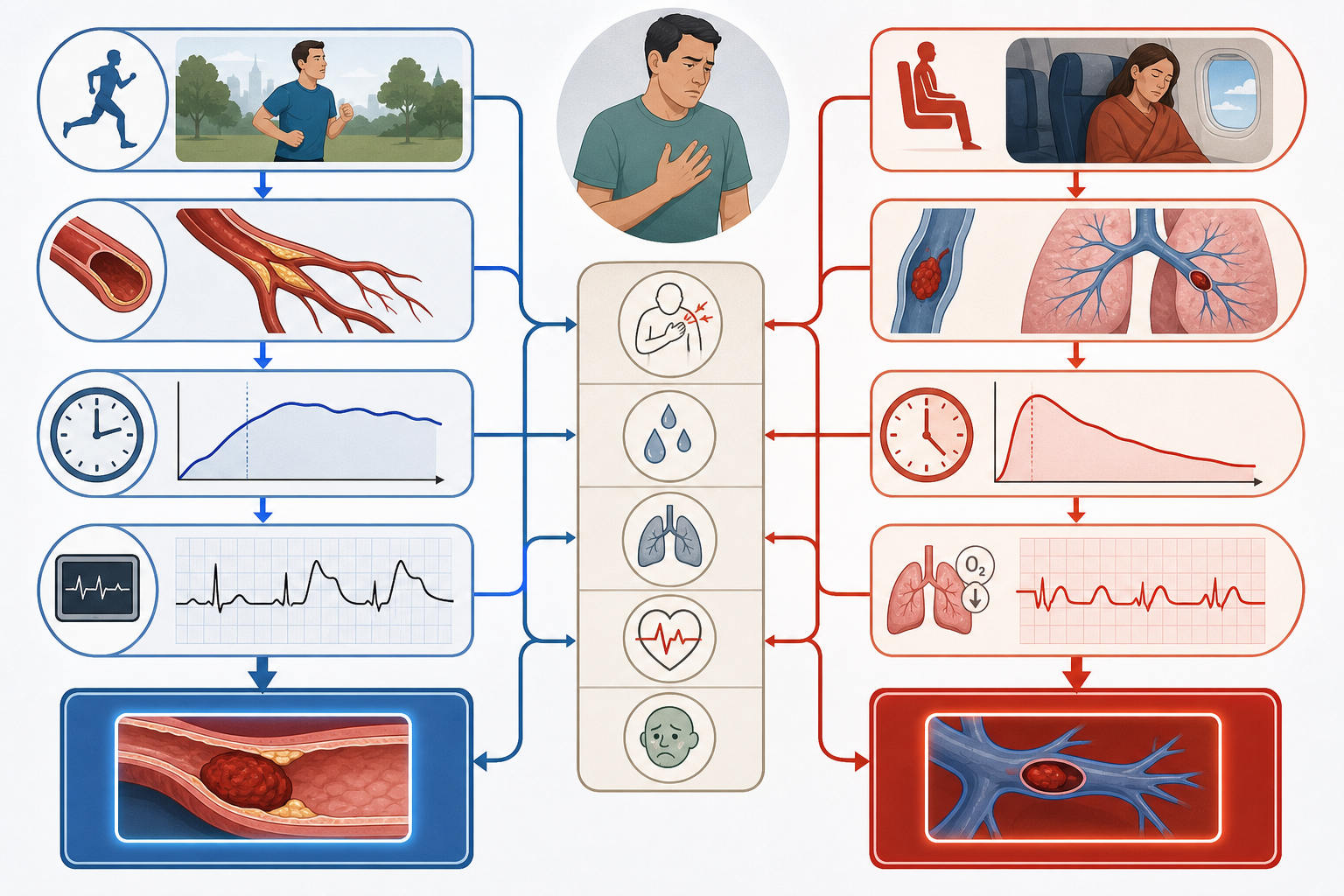
Many USMLE misses occur because you know both diseases independently but cannot distinguish them inside a vignette. Comparison should therefore be a required part of script building.
Use a small contrast grid:
| Comparison field | Condition A | Condition B | |---|---|---| | Typical setting | What raises prior probability? | What raises prior probability? | | Time course | Sudden, episodic, progressive, or chronic? | How does the course differ? | | Mechanism | What process produces the findings? | What alternative process produces overlap? | | Best discriminator | Which clue changes the decision? | Which opposing clue changes it back? | | Exam action | Diagnose, test, treat, or observe? | How does the action differ? |
Avoid using vague contrasts such as “A is more severe” unless you can define the finding that demonstrates severity. Strong discriminators are observable: timing, exposure, examination pattern, laboratory relationship, imaging feature, response to an intervention, or a contraindication.
Comparison also reduces the temptation to memorize buzzwords. A clue matters because it changes probability relative to another plausible diagnosis—not because it appeared in bold in a resource.
Update scripts without turning them into notebooks
An illness script should change when new questions expose a meaningful limitation. It should not expand every time you encounter an additional fact.
Use three update rules:
- **Replace:** Correct a false belief or an unreliable discriminator.
- **Refine:** Add a condition that changes when a finding is expected.
- **Link:** Connect the script to a close mimic, mechanism, complication, or management threshold.
Before adding a fact, ask: *Would this change recognition, differentiation, prediction, or action?* If the answer is no, the fact probably belongs in a reference note rather than the script.
Keep a visible revision line beneath each script:
**Last update:** Missed because I treated a shared finding as specific; revised the contrast line to emphasize the decision-changing clue.
This records the reasoning correction instead of merely documenting that another question was completed.
Retrieve the script on a realistic schedule
Rereading a polished script can create familiarity without proving that you can reconstruct it. In a randomized medical-education trial, repeated testing with feedback produced better long-term retention than repeated study of the same content. The trial comparing repeated testing with repeated study supports using scripts as retrieval tools, not just review sheets.
A practical schedule is:
| Time | Retrieval task | Pass criterion | |---|---|---| | Same day | Rebuild the six-line script without notes | Correct mechanism and discriminator | | 2–3 days later | Compare it with its nearest mimic | State both decision-changing clues | | 7 days later | Solve a new or previously unseen related question | Reach the answer through the script, not recalled wording | | 14–21 days later | Give a 30-second oral explanation | Concise representation, mechanism, and next decision |
These intervals are practical recommendations, not an official USMLE schedule. Adjust them around your question blocks and exam timeline.
For exam alignment, use the official USMLE Step 2 CK materials to review the content outline, sample questions, and question formats. Your retrieval practice should resemble the decisions required by official-style questions rather than becoming unlimited free recall of every fact associated with a disease.
Progress checkpoints that measure reasoning improvement
Count a script as improving only when it changes performance. Review your script set weekly using four checkpoints:
- **Compression:** Can you represent the case in one sentence without repeating the stem?
- **Mechanism:** Can you explain why the key findings belong together?
- **Discrimination:** Can you name the strongest clue separating the top two diagnoses?
- **Transfer:** Can you apply the script when the new question changes age, setting, wording, or requested task?
A simple scoring system works well: assign one point for each checkpoint completed without notes. Scripts scoring 0–2 need revision and earlier retrieval. Scripts scoring 3 need another contrasting case. Scripts scoring 4 can move to less frequent review.
Also monitor your next 20–40 related questions. If you continue missing the same distinction, do not simply retrieve the same script more often. Reassess whether the discriminator is wrong, too vague, or disconnected from mechanism.
Failure modes that make illness scripts less useful
Writing disease summaries instead of decision tools
A paragraph containing epidemiology, symptoms, diagnosis, and treatment may be accurate but difficult to retrieve. Compress it to the features that alter recognition or action.
Memorizing the original vignette
If your script preserves the patient’s exact age, wording, and laboratory values, you may recognize the old question rather than the disease pattern. Abstract the stem into a problem representation, then test the script on a different presentation.
Using pattern recognition without a mechanism check
A buzzword can activate the right answer while leaving you vulnerable when the clue is absent. Require at least one causal chain and one predicted finding in every script.
Building scripts for every miss
Some errors come from rushing, changing a correct answer without evidence, or overlooking the question’s final sentence. Record those as process errors. Reserve illness scripts for misses involving disease models, comparisons, mechanisms, or clinical decisions.
Adding too many competing diagnoses
A ten-condition differential creates review burden without sharpening the original decision. Start with the two options you actually confused. Add another only when a future question reveals a new recurring confusion.
Final takeaways
- Convert selected missed clinical questions into six-line illness scripts centered on presentation, mechanism, discriminators, and the required decision.
- Compare each condition with one close competitor so the script can guide choices rather than merely store facts.
- Update scripts by replacing errors, refining conditions, or linking meaningful relationships—not by collecting every new detail.
- Retrieve scripts from memory and apply them to altered cases to test transfer.
- Measure progress by improved compression, mechanistic explanation, discrimination, and performance on new questions.
Build your next study block with CoreStepPrep.