Active Recall Without Flashcard Overload
Use active recall for USMLE Step 1 and Step 2 CK without drowning in cards. Learn what to card, what to suspend, and how to review missed questions.
USMLE learners often recognize that active recall works, then accidentally turn it into a second full-time job: every missed question becomes three new flashcards, every detail feels “high yield,” and daily reviews expand until they displace question blocks.
The solution is not to abandon flashcards. It is to give each retrieval method a narrower job.
Use flashcards for durable, testable knowledge that should become automatic. Use practice questions for diagnostic and management reasoning. Use verbal retrieval to reconstruct mechanisms and illness scripts. Use comparison sheets when your real problem is distinguishing similar diagnoses.
That division keeps active recall aligned with the demands of Step 1 and Step 2 CK while preventing a growing card queue from controlling your schedule.
Why active recall does not require a flashcard for everything
Active recall means attempting to retrieve information before looking at the answer. Flashcards are one implementation, but so are answering a question, explaining a mechanism aloud, listing a differential from memory, or comparing two diagnoses without notes.
The evidence supports retrieval itself more strongly than any single platform. A large meta-analysis of classroom quizzing found that testing improved academic achievement compared with non-testing conditions, although the benefit varied with factors such as feedback, repetition, timing, and alignment between practice and assessment. A systematic review in health professions education also found that retrieval and distributed practice generally improved academic performance, while noting substantial variation among the included studies.
Flashcards can combine retrieval with spaced review, but that does not make them the best tool for every task. In one randomized study of medical students learning factual nephrology material, repeated flashcard testing improved recall at one week compared with repeated study, although the advantage was not present at six months and overall long-term recall was poor. The practical lesson is modest: retrieving facts is useful, but durable learning still requires continued contact, correction, and application.
**Evidence-backed principle:** effortful retrieval with feedback can strengthen learning.
**Practical CoreStepPrep recommendation:** match the retrieval format to what you need to reproduce on exam day. Do not convert every learning problem into a card.
Route every missed question to the right retrieval tool
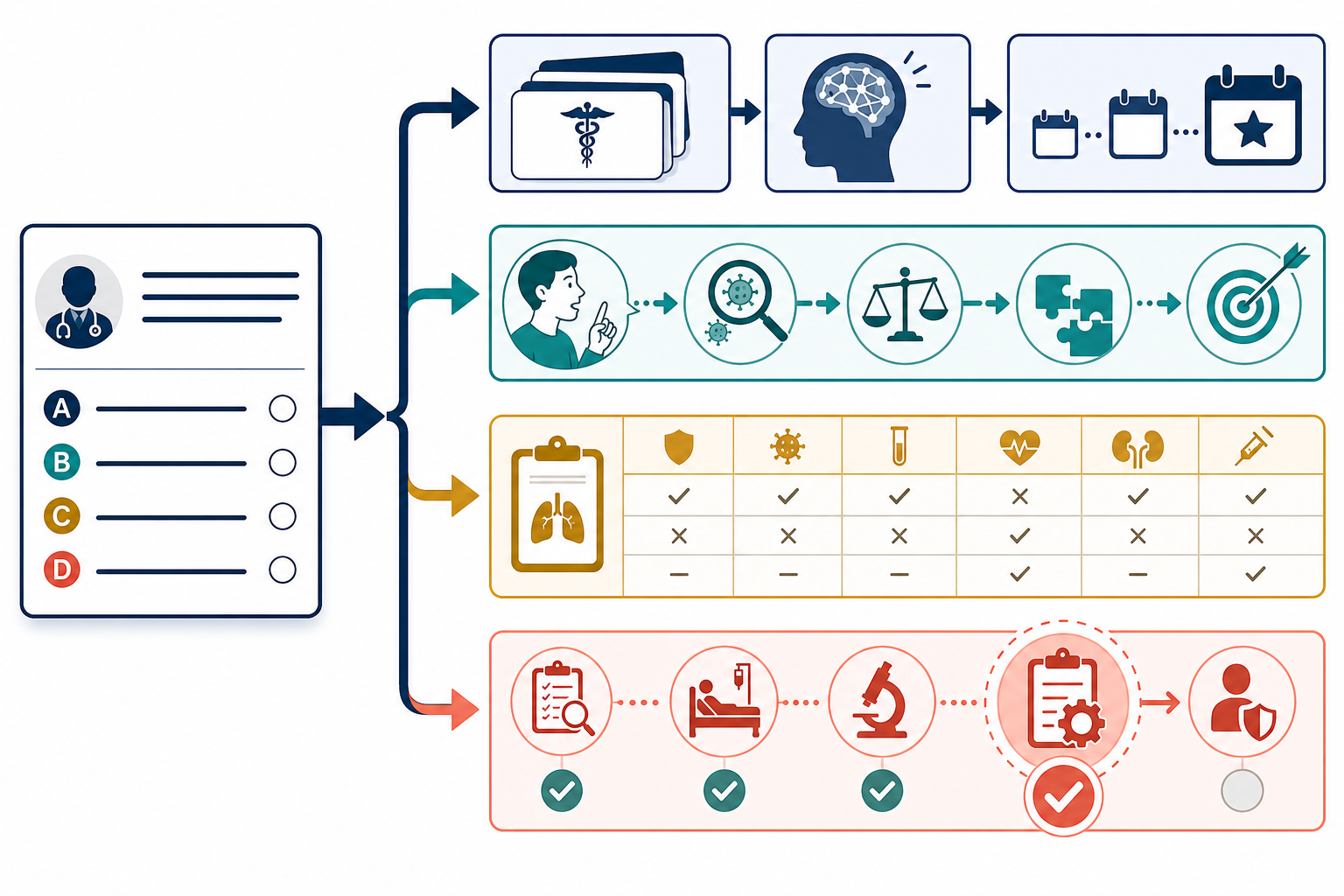
Before creating anything, identify why you missed the question. The same incorrect answer can reflect very different failures.
| Why you missed it | Best response | Flashcard? | |---|---|---| | You did not know a stable fact | Retrieve the fact in one direction | Usually | | You confused two similar diseases | Build a comparison sheet, then test the discriminators | Sometimes—only for the decisive distinction | | You knew the facts but misread the stem | Write a one-sentence process correction | No | | You could not connect mechanism to finding | Explain the causal chain aloud or on a blank page | Only if one link remains persistently weak | | You chose the wrong next step | Reconstruct the decision point using another vignette | Usually not | | You forgot a recurring threshold, adverse effect, association, or contraindication | Create one focused card | Usually | | You lacked the entire topic foundation | Review a concise source, then answer questions | Not yet |
This routing step prevents the common habit of treating “incorrect” as synonymous with “needs a card.”
A missed question about hyperthyroidism, for example, may not require a card that restates the entire disorder. If you knew the physiology but confused Graves disease with toxic multinodular goiter, a small comparison grid may be better. If you knew both presentations but forgot that a particular finding points toward one diagnosis, one discriminator card may be justified.
Reserve flashcards for durable, testable knowledge
A useful card should earn repeated access to your future study time. Create one only when the information passes most of these tests:
- **Durable:** It is unlikely to become obsolete during your preparation period.
- **Testable:** It can change an answer choice, differential, mechanism, or management decision.
- **Atomic:** The prompt has one clear retrieval target.
- **Reusable:** The fact applies beyond the original vignette.
- **Weak:** You could not reliably retrieve it before seeing the explanation.
- **Compact:** The answer can usually be stated in one sentence, short list, or simple causal chain.
Good candidates include classic mechanism-to-effect relationships, recurring adverse effects, important contraindications, inheritance patterns, core pathology associations, diagnostic discriminators, and compact management rules.
Poor candidates include complete explanations copied from a question bank, long lists with no organizing principle, facts you already retrieve reliably, and wording that makes sense only when paired with the original vignette.
Apply the two-minute card rule
Card creation should be fast. If a card requires more than about two minutes to write, one of three things is probably happening:
- You do not understand the concept well enough to compress it.
- The concept contains multiple retrieval targets.
- The material belongs in a comparison sheet or short concept review instead.
Pause and fix the underlying issue. Polishing a miniature textbook entry is not active recall.
Write prompts that demand the exam-relevant distinction
Weak card:
What should I know about nephritic syndrome?
Better card:
What urine microscopy finding supports a glomerular source of hematuria?
Weak card:
Compare SIADH and cerebral salt wasting.
Better card:
In a hyponatremic patient with concentrated urine, which volume-status finding favors cerebral salt wasting over SIADH?
The improved versions isolate a decision-changing retrieval target. If the full comparison matters, keep it on a one-page comparison sheet and use a few cards only for distinctions you repeatedly miss.
Use questions and verbal retrieval for clinical reasoning
Practice questions are active recall because they force you to retrieve and apply information under uncertainty. They also reveal whether you can recognize the relevant clues, exclude distractors, and commit to a decision.
Use the USMLE’s official preparation hub to locate official Step 1 and Step 2 CK practice materials. Those materials should help anchor your understanding of the exam’s style and expected applications; flashcards should support that work rather than replace it.
After reviewing a missed question, close the explanation and perform a 30- to 60-second verbal retrieval:
- State the diagnosis or tested concept.
- Name the two or three clues that should have triggered it.
- Explain why your answer was wrong.
- State the rule that would change your choice next time.
- Predict one way the concept could appear in a different vignette.
For Step 1, this may sound like a mechanism chain: molecular defect → cellular consequence → organ finding → clinical presentation.
For Step 2 CK, use a clinical decision chain: presentation → stability assessment → leading diagnosis → best next step → treatment or disposition.
If you can reconstruct that chain cleanly, a new card may add little. If one stable link repeatedly disappears—such as a drug toxicity or diagnostic discriminator—card that link alone.
Build comparison sheets for concepts that compete
Some errors are relational rather than factual. You may know the features of two disorders independently but fail when both appear among the answer choices.
Create a comparison sheet when:
- Two or more diagnoses repeatedly compete in your differential.
- Management changes based on one subtle discriminator.
- You keep mixing up mechanisms, laboratory patterns, imaging findings, or time courses.
- A flashcard would require a long, multi-column answer.
Limit each sheet to one page or one screen. Choose columns that affect decisions, such as typical setting, onset, defining mechanism, decisive clue, key test, and first management step. Then cover the sheet and reconstruct it from memory.
Do not reread comparison sheets passively. Retrieve them. A useful weekly drill is to draw the column headings from memory and fill only the decisive differences.
Create, suspend, and review cards from missed questions
Use a consistent card lifecycle so that your deck reflects current weaknesses rather than every weakness you have ever had.
Create a card only after correcting the miss
First explain the question in your own words. Then ask:
- What exact knowledge failure caused the miss?
- Would recalling one compact item have changed my answer?
- Is that item likely to matter again?
- Can I test it without copying the vignette?
If all four answers are yes, create one card. Occasionally a miss justifies two cards—for example, one mechanism and one adverse effect—but this should be the exception.
Suspend cards that no longer earn review time
Suspend or retire a card when:
- It is redundant with a clearer card.
- You answer it instantly across several reviews and apply it correctly in questions.
- It tests trivia that has not affected decisions.
- The prompt is vague, overloaded, or dependent on memorized wording.
- You repeatedly fail because the underlying concept needs relearning, not another repetition.
Suspension is not failure. It is workload control. You can reactivate a card if the same knowledge gap returns.
Review cards as a capped support block
Do reviews before or after questions, but set a time boundary. A practical starting cap is 30–45 minutes on most study days, adjusted for your schedule and preparation phase. This number is a workflow recommendation, not an official USMLE requirement.
When the cap is reached, stop and preserve time for questions and targeted review. If reviews consistently exceed the cap, reduce new cards, suspend low-value cards, and shorten overloaded prompts before increasing study time.
A realistic weekly workflow without card overload
| Study moment | Retrieval activity | Output | |---|---|---| | Start of day, 30–45 minutes | Due cards, with low-value cards flagged | Small, maintained deck | | Main study block | Timed or tutor-mode questions based on current phase | List of specific misses | | Immediately after each review set | Verbal reconstruction of missed or guessed items | Corrected reasoning chain | | End of question review, 10–15 minutes | Route each miss using the decision table | Zero to a few new cards; comparison-sheet updates | | Two or three times weekly, 15 minutes | Blank-page mechanism or illness-script retrieval | Identified weak links | | Weekly, 30 minutes | Deck audit and comparison-sheet retrieval | Suspended cards and next-week priorities |
A useful operating rule is that card creation should remain a minor output of question review, not its main product. If reviewing 20 questions produces 20 new cards, your threshold is probably too low.
Progress checkpoints that measure more than the queue
Evaluate the system every week using four checkpoints:
- **Question transfer:** Are previously reviewed concepts being answered correctly in new vignettes?
- **Reasoning recovery:** Can you explain why the correct choice wins without reopening the explanation?
- **Deck control:** Are reviews fitting inside the planned block?
- **Error recurrence:** Are the same knowledge gaps returning, or are new errors becoming more specific?
At the two-week mark, look for directional improvement rather than a perfect percentage. Your deck should feel more selective, repeated errors should be easier to explain, and question review should produce fewer but better cards.
If question performance is not transferring, do not automatically add more cards. Inspect whether your misses come from knowledge, interpretation, prioritization, or management sequencing. Only the first category consistently points toward flashcards.
Common failure modes and their fixes
**Failure: Copying explanations into cards.** Fix: Write the answer from memory in one sentence. If that is impossible, relearn the concept first.
**Failure: Making a card for every unfamiliar detail.** Fix: Ask whether the detail would change a future answer. Curiosity is valuable, but not every fact belongs in the review queue.
**Failure: Using recognition instead of retrieval.** Fix: Remove clues that reveal the answer through formatting or wording. Your prompt should make you generate the target.
**Failure: Completing cards instead of questions.** Fix: Cap reviews and protect the question block. The deck is support work, not the final performance task.
**Failure: Repeatedly missing a card without changing it.** Fix: Diagnose the problem. Split the card, rewrite the prompt, add a brief mechanism, or suspend it while you rebuild the concept.
**Failure: Keeping cards because deleting feels wasteful.** Fix: Judge cards by future value, not past effort. A card that consumes time without changing decisions is sunk cost.
Final takeaways
- Active recall includes questions, verbal reconstruction, blank-page retrieval, comparison sheets, and flashcards.
- Reserve cards for compact, durable knowledge that can change a future answer.
- Route every missed question by its actual cause before creating a card.
- Suspend redundant, trivial, overloaded, or consistently mastered cards.
- Measure success by transfer to new questions and controlled review time—not by deck size or streak length.
Build your next study block with CoreStepPrep.